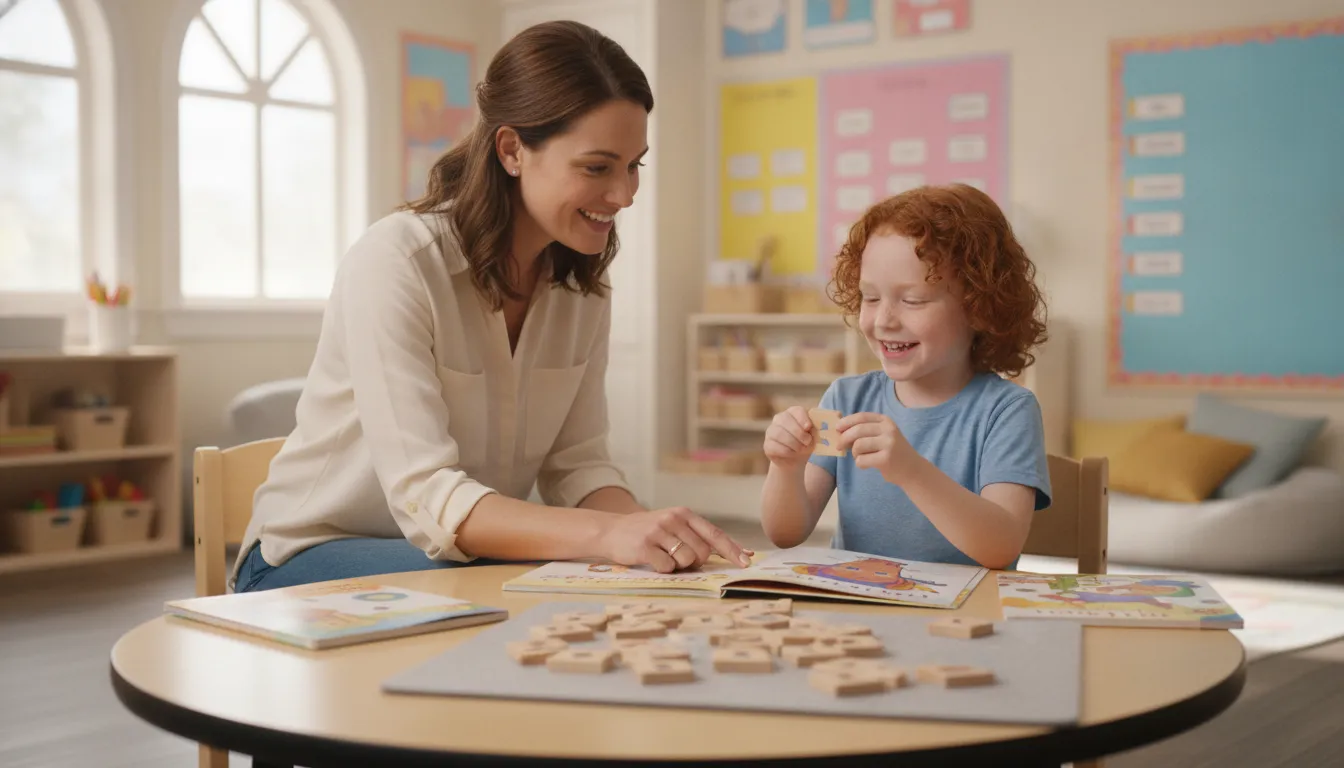
Students with dyslexia are capable readers who learn differently. They benefit from instruction that makes the structure of spoken and written language clear rather than vague or incidental. Teachers can support that work through explicit phonics, guided practice, multisensory routines, and reading materials that match the skills students have actually been taught.
The most effective dyslexia resources for the classroom reinforce systematic phonics and phonemic awareness through a logical sequence. Decodable texts give students repeated practice with newly learned sound-spelling patterns, while Orton-Gillingham routines connect auditory, visual, and tactile learning. When instruction is explicit and cumulative, students build accuracy and confidence without guessing at unfamiliar words.
This guide gives classroom teachers a practical starting point. It covers evidence-based strategies, the role of multisensory instruction, how Orton-Gillingham works, and the classroom accommodations that help dyslexic students access grade-level content. Each section keeps the Science of Reading at the center, with research-backed methods teachers can apply the same day.
Little Lions Literacy creates decodable books for structured literacy and Orton-Gillingham instruction. With the right combination of direct teaching, targeted practice, and supportive accommodations. Teachers can help every student progress toward reading success without asking them to rely on memorization or guesswork.
Shop our decodable books to build a classroom library rooted in the science of reading.
Classroom teachers play a central role in helping students with dyslexia access reading instruction, grade-level learning, and meaningful participation. Support starts with clear routines, careful observation, and collaboration with intervention specialists and families.
Teachers should provide explicit, systematic instruction that connects sounds, letters, words, and meaning. Lessons should make the target skill clear, model the process, and give students guided practice before independent work. When possible, brief small-group instruction can provide focused practice on foundational code-based reading skills. A review of research found that explicit, systematic intervention delivered individually or in small groups is likely to improve these skills for elementary students with dyslexia.
Read the ERIC review of reading interventions for details about code-based and meaning-based instruction.
Students benefit when teachers use consistent routines for phonemic awareness, phonics, word reading, spelling, and connected text. Keep directions concise and model each step. Provide enough repetition for students to apply a newly taught pattern without relying on guessing or memorization.
Use quick checks during instruction to identify where a student needs more modeling, practice, or review. Record patterns in errors rather than treating each mistake as an isolated problem. This information can guide small-group lessons and help the instructional team adjust support.
Dyslexia does not have one quick fix or one prescribed intervention. Students respond differently, so teachers should avoid presenting a single program as the answer for every learner. Instead, use evidence-based instruction, monitor progress, and adjust the intensity or focus when data show that a student needs more support.
Classroom teachers can also protect access to the wider curriculum. Offer appropriate ways to engage with grade-level content while continuing explicit reading instruction. Audiobooks, text-to-speech, oral responses, extra processing time, or reduced copying demands may help a student demonstrate knowledge without removing the learning goal. Coordinate these supports through the student’s educational team.
Research on inclusive classroom practices emphasizes the teacher’s role in ensuring students with dyslexia have the same opportunities to achieve as their peers.
Finally, create a classroom culture that treats support as a normal part of learning. Avoid asking students to read unfamiliar text aloud without preparation. Celebrate accurate effort, strategy use, and growth. When instruction is explicit and expectations remain appropriately high, students can participate as capable members of the classroom community.
Effective instruction for students with dyslexia is explicit, systematic, and responsive to individual needs. It does not depend on a single program or a quick fix. Instead, teachers use clear routines, monitor progress, and adjust support when students need more practice.
Research reviews support explicit intervention that addresses both the code and meaning dimensions of reading and writing. When delivered individually or in small groups, this approach is likely to improve foundational code-based reading skills in elementary students. Read the research review on reading interventions for students with reading difficulties for the full evidence base.
Students need direct instruction in the alphabetic code. This includes phonemic awareness, sound-symbol relationships, decoding, word reading, and spelling. Teachers should model each skill, guide practice, and provide opportunities for students to apply it in words and connected text.
Systematic routines help reduce guesswork. A lesson might begin with phoneme work, move to sound-spelling patterns, and then apply those patterns to reading and writing. The sequence should build from previously taught skills rather than introduce unrelated patterns without preparation.
Use consistent language and prompts across lessons. Ask students to identify the sounds, connect them to graphemes, blend the word, and check whether the result makes sense. This process supports both accurate word identification and meaning.
Research indicates that standardized protocols, multiple components, and longer intervention duration can produce stronger effects, particularly for students in upper elementary grades. In practice, this means protecting regular instructional time instead of relying on occasional remediation.
A strong intervention block can include phonemic awareness, explicit phonics, word reading, spelling, fluency, vocabulary, and comprehension. Each component should connect to the others. For example, students can decode a pattern, spell words with that pattern, and discuss the meaning of those words in a short passage.
Reading and writing should reinforce one another. After students read words with a new pattern, have them segment and spell selected words. They can then write a sentence using one or more of those words. This practice strengthens the connection between sounds, letters, words, and meaning.
Teachers can also use brief dictation, sentence construction, and written responses during intervention. Integrating reading and writing interventions shows promise for elementary students with reading difficulties. Keep feedback immediate, specific, and focused on the skill being taught.
Progress monitoring helps teachers identify which routines are working. Use student responses, decoding accuracy, spelling attempts, fluency, and comprehension to guide the next lesson. These science of reading classroom tools can support consistent instruction and purposeful review.
Orton-Gillingham is a structured literacy approach that teaches reading through explicit, systematic, and cumulative lessons. Instruction connects speech sounds, letters, spelling patterns, and reading in a deliberate sequence. This approach gives students repeated opportunities to notice, practice, and apply each skill.
Phonemic awareness is a central part of this work. Students with dyslexia may find it difficult to identify, separate, blend, or manipulate the individual sounds in spoken words. Without those skills, connecting sounds to print becomes harder. Teachers can address this need through direct oral practice before asking students to read or spell the corresponding words.
Orton-Gillingham lessons are multisensory. Students hear a sound, see its spelling pattern, say it, and represent it through movement or touch. This may include tapping phonemes, tracing letters, building words with tiles, and reading the words in connected text. Auditory, visual, and kinesthetic-tactile pathways reinforce the same concept without relying on memorization alone.
Decodable books provide controlled practice after a phonics pattern has been taught. Students apply the target pattern in words and sentences that match their current instruction. Repeated reading builds accuracy and helps students connect successful decoding with meaningful text.
Little Lions Literacy decodable books align with structured literacy and Orton-Gillingham principles by supporting repeated practice of newly learned phonics skills. Teachers can introduce a pattern during direct instruction, practice it with spoken words, and then use a matched book for reading application. This sequence helps keep the reading task focused and predictable.
For a broader explanation of structured literacy principles, consider how explicit skill instruction, cumulative review, and meaningful reading work together. The goal is not to make every lesson identical. It is to give students enough carefully sequenced practice to build durable skills.
Orton-Gillingham is not a quick fix or a single script for every learner. Teachers should adjust pacing, review prior skills, and monitor how students respond. A consistent, multisensory routine can make phonics instruction more accessible while preserving high expectations for reading growth.
Sources: ERIC research on dyslexia instruction and Little Lions Literacy.
Multisensory instruction gives students more than one way to engage with a phonics concept. A teacher might ask a student to see a letter pattern, say its sound, trace the letters, and build a word with tiles. Each action reinforces the same connection between speech sounds and print.
This approach commonly combines auditory, visual, and kinesthetic-tactile experiences. Students hear the phoneme, look at the grapheme, and use movement or touch while reading and spelling. These linked actions can make abstract sound-symbol relationships more concrete, especially when students need repeated practice.
| Sensory channel | Example activity | Reading skill reinforced |
|---|---|---|
| Auditory | Hear the sound and blend it with the next one aloud. | Phonemic awareness and segmenting. |
| Visual | Point to the letter pattern while reading a decodable word. | Letter-sound connections. |
| Kinesthetic | Trace the letter, tap phonemes, or build a word with letter tiles. | Automatic word recognition and spelling. |
Begin with one clearly taught skill. For example, introduce a short-vowel pattern through explicit modeling. Say the target sound and have students repeat it. Display the corresponding letter or pattern, then guide students in tracing it while saying the sound.
Next, let students build words that use the pattern. They can move sound cards, tap phonemes, or arrange letter tiles from left to right. Ask them to blend the sounds, read the word, and spell it. Keep the routine focused on the pattern students are learning rather than adding unrelated features.
After word work, provide connected reading practice. Decodable books for struggling readers can give students controlled opportunities to apply newly learned phonics skills in text. Rereading selected pages can strengthen accuracy and help students notice the target pattern in meaningful sentences.
The Science of Reading supports explicit, systematic instruction in phonemic awareness, phonics, and other foundational skills. Multisensory routines do not replace that instruction. They provide practical ways to teach, practice, and reinforce it.
A logical scope and sequence keeps the routine purposeful. Teach skills in a planned order, review previously taught patterns, and introduce new patterns only when students are ready. This structure helps teachers connect each lesson to prior learning instead of asking students to memorize isolated words.
Multisensory instruction is associated with Orton-Gillingham and other structured literacy approaches. Little Lions Literacy decodable books support repeated practice of newly learned phonics skills within this type of instruction. For additional research context on inclusive and evidence-based support for students with dyslexia, see the ERIC review of classroom practices.
Use the routine consistently, monitor student responses, and adjust the amount of modeling or practice when needed. The goal is not to add activities for their own sake. The goal is to make phonics connections clear, memorable, and useful during real reading and spelling.
Decodable texts work best when they follow the same instructional order as the phonics skills students are learning. This connection turns reading practice into an opportunity to apply new knowledge, rather than a test of memory.
A logical scope and sequence introduces skills in a deliberate progression. Students may begin with simple sound-symbol relationships and regular words. Instruction can then build toward digraphs, blends, long-vowel patterns, multisyllabic words, and more complex syllable types. The exact sequence should reflect the phonics program and each student’s response to instruction.
This structure matters for students with dyslexia. When a book includes patterns that have not been taught, students may rely on pictures, context, memorization, or guessing. A controlled text keeps attention on the letter-sound relationships that instruction has already established. Repeated success helps students practice accurate decoding and develop more efficient word-reading habits.
Start by identifying the phonics pattern taught in the current lesson or intervention cycle. Select a short passage that gives students several opportunities to read that pattern. Before reading, review the sound-spelling connection and blend a few words together. Then invite students to read the text aloud, individually or with a partner.
Listen for the process, not only the final answer. If a student pauses, guide attention back to the graphemes and sounds. Ask the student to point, segment, and blend the word. Avoid supplying the word too quickly. This routine reinforces the idea that print carries the information needed for reading.
After reading, briefly revisit words that caused difficulty. Students can build, write, or mark those words before rereading the sentence. A second reading provides additional practice with the same patterns while supporting fluency and confidence. Teachers can also connect the text to a short spelling or dictation activity, reinforcing the reading and writing relationship.
Keep a simple record of the skills introduced, the texts used, and the patterns that still require practice. Use this record during small-group planning. It can help prevent students from moving ahead before they are ready, while also making it easier to provide focused review.
Little Lions Literacy decodable books are designed to align with structured literacy and Orton-Gillingham methodologies. They provide repeated practice with newly learned phonics skills, supporting a multisensory classroom routine. This approach can complement broader dyslexia-friendly decodable books guidance without replacing individualized instructional decisions.
For a broader explanation of controlled texts and their classroom role, read this comprehensive guide to decodable readers. The goal is not to rush through a series. It is to give each learner enough accurate, supported practice to apply phonics knowledge with increasing independence.
Reasonable accommodations remove barriers without lowering the learning goal. They help students with dyslexia access instruction, show what they know, and participate with greater independence.
The International Dyslexia Association groups accommodations into three areas: materials, interactive instruction, and student performance. This framework applies in both general education and special education classrooms. Review the student’s plan, classroom demands, and response to support before selecting specific tools. The Yale Center for Dyslexia and Creativity summarizes these accommodation principles.
Students may need alternative ways to access text and information. Audiobooks and text-to-speech tools can provide access to grade-level content when decoding demands would otherwise limit comprehension. Digital text, recorded directions, and teacher-provided notes can also reduce the burden of copying while preserving the lesson objective.
Keep direct phonics instruction separate from access accommodations. A student can listen to a science passage while receiving explicit instruction and guided practice in phonemic awareness, phonics, spelling, and word reading. Early identification and high-quality, evidence-based literacy instruction remain essential. An accommodation supports access, but it does not replace structured reading instruction.
Give directions in clear steps, then ask the student to repeat or explain the first step. Pair oral explanations with visual models. Provide additional processing time before expecting an answer. In reading lessons, model the skill, practice it with the student, and then offer an opportunity for independent application.
Interactive instruction can include explicit prompts for segmenting, blending, and rereading. Use controlled text that matches the phonics pattern being taught. Little Lions decodable books support repeated practice of newly learned phonics skills within structured literacy and Orton-Gillingham-aligned instruction. Shop our decodable books for classroom practice materials.
Student performance accommodations change the response method or conditions, not the knowledge being assessed. Options may include extended time, oral responses, speech-to-text, reduced copying, or a quiet testing space when appropriate. Avoid grading a science explanation primarily on spelling when spelling is not the target skill.
Normalize these options for the whole class whenever possible. Offering audio directions, flexible response formats, or extra planning time to any student reduces stigma. It also communicates that support is a normal part of learning, not a sign of lesser ability.
Teachers should monitor whether each accommodation improves access and independence. Coordinate with the student’s support team, document what works, and revise support as classroom demands change. Inclusive practices help students with dyslexia receive the same opportunities to achieve as their peers, while evidence-based instruction builds the underlying literacy skills.
Use explicit, systematic phonics instruction in a small group. Teach phonemic awareness, decoding, spelling, and connected reading with cumulative practice. Provide clear directions, frequent feedback, and enough time to respond.
Useful resources include decodable books, phoneme-grapheme mapping tools, sound walls, controlled spelling practice, and audiobooks for access. Choose materials that follow a logical scope and sequence and support explicit instruction.
A decodable text is a practical tool for applying recently taught phonics. Text-to-speech or audiobooks can also support access to grade-level information when reading the material independently is not the learning goal. The International Dyslexia Association lists both as reasonable classroom accommodations.
No single program is a universal quick fix. Effective instruction is explicit, systematic, cumulative, and responsive to student performance. Orton-Gillingham-informed lessons can provide a structured multisensory framework.
Yes. Decodable books let students practice taught sound-spelling patterns without relying on pictures or guessing. Select books that match the learner’s current phonics skills and increase complexity gradually.
Supporting students with dyslexia does not require more instructional hours. It requires the right materials and a clear sequence. Little Lions Literacy offers decodable books and phonics resources built on the Science of Reading, designed for Pre-K through second grade.
Every set follows a logical scope and sequence, so each new skill builds on the last. That structure fits naturally into Orton-Gillingham and other structured literacy routines teachers already use.
Browse our collection of decodable books
Bring evidence-based, phonics-first reading practice into your classroom today.