
Vowel digraphs are one of the most important phonics patterns children encounter after mastering short vowels and consonant digraphs. They are the key to reading longer, more interesting words like rain, boat, and tree. Without a solid understanding of vowel digraphs, young readers often get stuck trying to sound out each vowel separately, which leads to frustration and slow reading.
This guide covers everything parents and teachers need to know about vowel digraphs, including a complete list, word examples for every common pair, and proven teaching strategies rooted in the science of reading.
Explore Our Vowel Team Decodable Books
A vowel digraph is a combination of two vowel letters that represent one single vowel sound. The two letters work as a team. Neither letter says its individual sound. Instead, they combine to produce a new, single sound.
For example, in the word boat, the letters o and a sit side by side. You do not hear /o/ and then /a/. You hear one smooth long o sound: /ō/. That is a vowel digraph in action.
You may have heard the old phonics saying: “When two vowels go walking, the first one does the talking.” This means that in many vowel digraphs, the first vowel says its long name and the second vowel is silent. While this rule has plenty of exceptions, it is a helpful starting point for young readers.
Vowel digraphs are sometimes called vowel teams. The terms are closely related, though “vowel teams” is a slightly broader category that can include patterns with consonant letters like ow and ay (where w and y act as vowels).
In a structured phonics program based on the science of reading, vowel digraphs are introduced after children can:
Once these foundations are secure, children are ready to tackle words where two vowels make one sound.
Below is a complete vowel digraphs list organized by the sound each pair makes. For every digraph, you will find the sound it produces, where it typically appears in a word, and a word list you can use for practice.
The digraphs ai and ay both produce the long a sound. The key spelling rule is position: ai appears in the middle of a word, and ay appears at the end.
ai words:
| rain | tail | pain | wait | |
| sail | train | brain | chain | snail |
| paint | saint | grain | stain | plain |
ay words:
| day | say | play | stay | way |
| may | pay | ray | hay | clay |
| pray | spray | tray | stray | gray |
Example sentences:
– It started to rain on the day we went to the bay.
– The snail left a trail along the way.
Teaching Tip: Introduce ai and ay together so children learn the position rule from the start. Practice sorting words into “middle” and “end” columns to reinforce the pattern.
Both ee and ea commonly produce the long e sound. ee is the more reliable of the two, as it almost always says /ē/. ea is trickier because it can also produce the short e sound (as in bread) and occasionally the long a sound (as in steak).
ee words:
| see | bee | tree | free | three |
| feed | seed | need | weed | speed |
| feet | meet | sleep | sheep | green |
ea words (long e sound):
| eat | sea | tea | read | team |
| bead | bean | clean | dream | speak |
| reach | teach | beach | peach | cream |
ea words (short e sound — exceptions):
| bread | head | dead | read (past) | spread |
| thread | dread | ahead | instead |
Example sentences:
– The bee landed on a leaf in the tree.
– We eat cream and peach at the beach.
Teaching Tip: Start with ee because it is consistent. Introduce ea (long e) next. Save the ea exceptions (short e) for later, after children are confident with the primary pattern.
The digraph oa makes the long o sound and usually appears in the middle of a word. The digraph ow can make the long o sound (as in snow) or the /ou/ diphthong sound (as in cow). When teaching vowel digraphs, focus first on the long o pronunciation of ow.
oa words:
| boat | coat | goat | road | soap |
| toad | load | moan | foam | toast |
| float | groan | coach | roast | coast |
ow words (long o sound):
| bow | low | row | show | snow |
| blow | flow | grow | know | slow |
| glow | throw | follow | yellow | window |
Example sentences:
– The goat rode in a boat down the road.
– The snow started to flow and grow.
Teaching Tip: Because ow has two sounds, teach the long o version first alongside oa. Introduce the /ou/ sound of ow (as in cow) later when covering diphthongs.
The digraph oo is unique because it makes two different sounds: the long /ōō/ as in moon and the short /ŏŏ/ as in book. Children need to learn both.
oo words (long sound — as in moon):
| moon | food | pool | cool | room |
| soon | too | zoo | broom | spoon |
| bloom | proof | tooth | roof | smooth |
oo words (short sound — as in book):
| book | cook | look | hook | took |
| good | wood | stood | foot | wool |
| brook | shook | crook | nook |
Example sentences:
– The moon shone over the pool.
– She took a book and stood by the brook.
Teaching Tip: Use picture sorts to help children distinguish between the two oo sounds. Group “moon words” and “book words” separately so they internalize the difference.
The digraph ie can say the long i sound (/ī/) as in pie or the long e sound (/ē/) as in piece. The digraph ue typically says the long u sound (/ōō/) as in blue.
ie words (long i sound):
| pie | tie | die | lie | vie |
| dried | fried | tried | cried | spied |
ie words (long e sound):
| piece | field | chief | brief | thief |
| shield | yield | belief | relief |
ue words:
| blue | true | clue | glue | flue |
| sue | due | hue | statue | rescue |
Example sentences:
– She ate a pie under the blue sky.
– The chief found a clue in the field.

This is one of the most common questions parents and teachers ask. The terms sound similar, but they describe different things.
A vowel digraph produces one steady vowel sound. When you say the word rain, your mouth stays in one position the entire time you produce the /ā/ sound.
A diphthong produces a gliding sound where the mouth moves from one vowel position to another within the same syllable. When you say coin, your mouth starts in one position and glides to another. You can feel the movement.
| Feature | Vowel Digraph | Diphthong |
|---|---|---|
| Sound type | Single, steady sound | Gliding sound (two positions) |
| Mouth movement | Stays still | Moves during the sound |
| Examples | ai (rain), ee (feed), oa (boat) | oi/oy (coin, boy), ou/ow (house, cow) |
The “Mouth Test”: Say a vowel digraph word like boat and notice your mouth stays in one place. Now say a diphthong word like coin and feel your mouth glide. This simple test helps children (and adults) tell the difference instantly.
Teaching vowel digraphs effectively requires a systematic, explicit approach. Here are six strategies that work, whether you are a classroom teacher or a parent working at the kitchen table.
Do not try to teach all vowel digraphs at once. Start with one pair (ai/ay is a great first choice because the position rule is clear). Spend several days on it before moving to the next. This builds mastery rather than confusion.
For digraph pairs like ai/ay, oa/ow, and oi/oy, teach the spelling rule tied to position in the word. “If you hear the long a sound in the middle of a word, try ai. If it is at the end, use ay.” This gives children a decision-making tool for both reading and spelling.
Write vowel digraph words on cards and have children sort them by pattern. For example:
– Sort by digraph: ai words in one pile, ay words in another
– Sort by sound: long oo words vs. short oo words
– Mixed sort: ai, ee, and oa words together
Word sorting builds pattern recognition, which is the engine of fluent reading.
Say a word aloud and have children write it. Start simple (rain, feet, boat) and progress to words with blends (train, sleep, float). Dictation strengthens the spelling side of phonics, which reinforces reading.
This is the most important strategy. Decodable books that focus on specific vowel digraph patterns give children the chance to practice reading real text with controlled vocabulary. Unlike leveled readers that encourage guessing, decodable books ensure every word is an opportunity for genuine decoding.
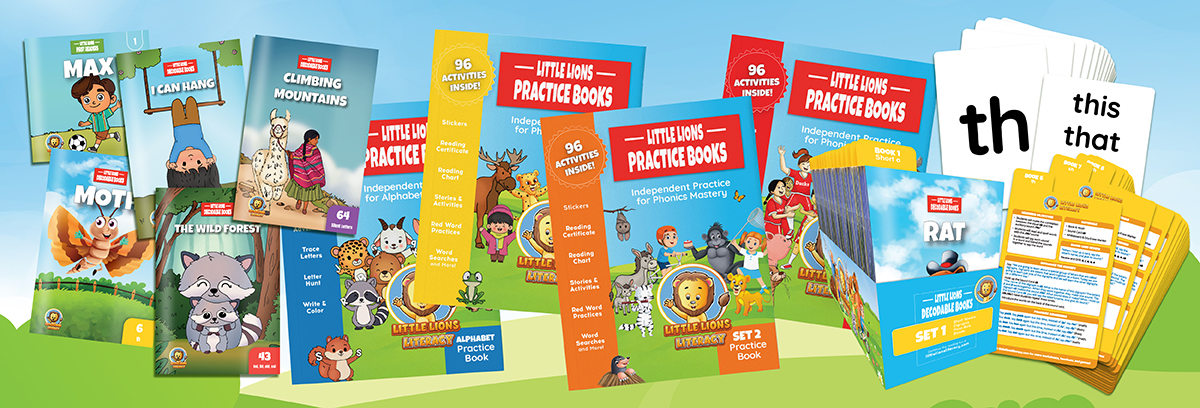
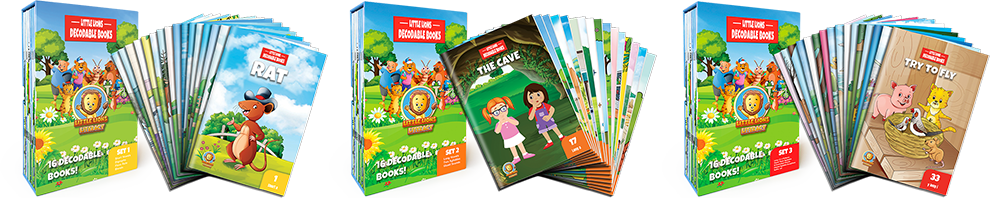
The Little Lions Decodable Books follow a structured scope and sequence that introduces vowel digraphs systematically. Children practice one pattern at a time in the context of engaging stories, which builds both fluency and comprehension.
Tap into different learning modalities:
– Trace and say: Have children trace the digraph letters in sand or shaving cream while saying the sound
– Sound boxes: Use Elkonin boxes where children push tokens into boxes for each sound, showing that the two vowel letters fill only one box
– Highlight and hunt: Give children a passage and ask them to highlight every vowel digraph they find

Understanding where vowel digraphs sit in a structured phonics scope and sequence helps parents and teachers know when to introduce them. Here is a typical progression:
The Little Lions Decodable Books are organized to follow this progression. Sets 1 and 2 cover short vowels and consonant digraphs, while later sets introduce vowel digraphs and long vowel patterns. This means your child reads books at exactly the right level for the patterns they are learning.
View All Little Lions Book Sets
A vowel digraph is two vowel letters that sit side by side and produce one single vowel sound. For example, the ea in beach makes one long e sound, not two separate sounds. Vowel digraphs are also called vowel teams, and they are a fundamental part of phonics instruction for children in kindergarten through second grade.
The most common vowel digraphs in English are ai, ay, ee, ea, oa, ow, oo, ie, and ue. Together, these cover the majority of vowel digraph patterns children encounter in early reading. Learning them in a systematic order, starting with the most predictable patterns first, builds confidence and reading fluency.
Consonant digraphs are two consonant letters that make one consonant sound, like sh in ship or ch in chip. Vowel digraphs are two vowel letters that make one vowel sound, like ai in rain or oa in boat. Both are two-letter combinations that produce a single sound, but they involve different types of letters.
No. A vowel digraph produces one steady vowel sound where the mouth stays in one position (like ai in rain). A diphthong is a gliding sound where the mouth moves from one vowel position to another within the same syllable (like oi in coin or ou in house). The mouth test, feeling whether your mouth moves during the sound, is the easiest way to tell them apart.
Children are typically ready for vowel digraphs after they can read short vowel CVC words fluently and have learned consonant blends and digraphs. In most programs, this falls in late kindergarten or first grade. The key sign of readiness is fluent CVC decoding, not age.
There are approximately 9 to 12 common vowel digraphs taught in early phonics programs, depending on how you categorize them: ai, ay, ee, ea, oa, ow, oo, ie, ue, ey, and ei. Some programs also include ew and au as vowel digraphs or vowel teams.
Browse All Little Lions Decodable Books
Written by Karina Richland, M.A., author of the Little Lions Decodable Books and the PRIDE Reading Program. Karina has an extensive background in working with students of all ages and various learning modalities, with many years of research into learning differences and differentiated teaching practices.