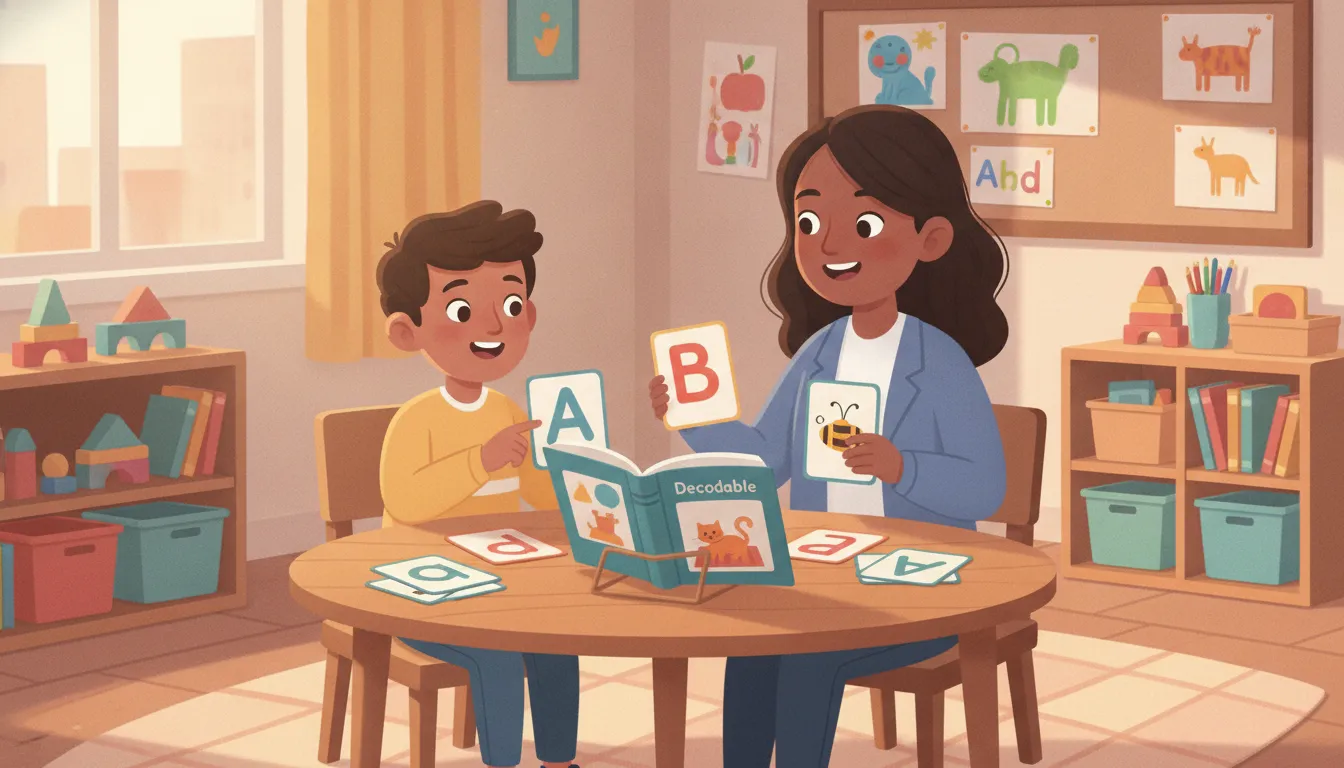
A child who cannot hear single sounds in spoken words will often struggle to learn phonics. This hearing gap is a common hurdle for early readers.
Phonics vs phonemic awareness is a look at two distinct but related skills that children need to become strong readers. Phonemic awareness is the ability to hear and change the small sounds in spoken words without using any print. In contrast, phonics is the process of mapping those spoken sounds to written letters and patterns to decode words on a page. Understanding decoding vs encoding is essential for helping children master these skills. According to the IRIS Center at Vanderbilt University, phonemic awareness is the best way to tell how easily a student will learn to read. While phonemic awareness happens with the eyes closed, phonics needs the eyes to be open to see the text. Both skills must work as one to help a child move from speaking to fluent reading and writing.
Knowing how they differ helps teachers and parents give the right kind of support at the right time. We will look at how these methods work in the classroom and at home to build strong readers who love to learn. You can see the main points in Phonics vs phonemic awareness at a glance. The path begins with
Many people use the terms phonics and phonemic awareness as if they mean the same thing. But they are two clear and distinct skills. Phonemic awareness deals only with the sounds we speak. Phonics connects those sounds to the letters we write. You can practice phonemic awareness in the dark. To do phonics, you must see the words on a page.
Knowing the gap between these two skills is a key part of the science of reading. Phonemic awareness is auditory. This means it is all about what we hear. Phonics is about how we map those sounds to print. Both are needed for a child to become a strong reader and a good speller.
Phonemic awareness is the skill to notice and move the small sounds in words. These tiny units of sound are called phonemes. There are 44 speech sounds in our language. Kids use their ears to hear, blend, and swap these sounds out loud. They might play games where they take the first sound off a word to make a new one. This work is the core of early phonemic awareness activities.
By focusing on sounds, kids learn how words are built. They learn to break a word like “cat” into three sounds: /k/, /a/, and /t/. This is called segmenting. They also learn to put those sounds back to make the word. This is called blending. These oral skills build the base a child needs before they ever touch a book. It prepares their brain for the next step in learning.
| Feature | Phonemic Awareness | Phonics |
|---|---|---|
| Main Focus | Spoken sounds only | Sounds and letters |
| Main Tool | Ears and voice | Eyes and the page |
| Final Goal | Hear and move sounds | Read and spell words |
| One Way | Oral rhyming games | Sounding out a word |
Phonics moves from the ear to the eye. It teaches how spoken sounds match the 26 letters of our alphabet. Once a child can hear a sound, they learn to find the letter that makes it. Experts at Vanderbilt University state that this skill is a top sign of future reading success. It helps kids turn printed marks into words that have meaning. This step is key for decoding new words.
Phonics also helps with spelling. When kids know which letters make which sounds, they can write the words they say. This link between sound and print is what lets us read books and write stories. Phonics starts with simple letter sounds and moves to hard patterns. Teaching these rules in a clear way helps all kids learn to read more easily.
Both skills must work together so a child can read well. A student might know letter sounds but struggle to blend them out loud. This child has a gap in phonemic awareness. They know the parts but cannot put them together. Another child might blend sounds well but mix up the letters for vowels. This shows a phonics problem. They can hear the sound but do not know the right letter for it.
Finding these gaps early helps teachers give the right help to every student. Some kids need more work with their ears. Others need more work with their eyes. When we teach both well, we help prevent reading struggles later on. Using phonological skills like rhyming can also help build this base. Strong skills in both areas lead to better reading for all children.
Phonemic awareness is the skill of hearing and working with the smallest units of sound in speech. These units are called phonemes. When a child has this skill, they can pick apart the sounds in words they hear.
It is a purely oral skill that does not involve letters or print. Keep this in mind when you look at phonics vs phonemic awareness. Experts view this skill as the top sign of how well a child will learn to read.
In English, there are 26 letters but 44 distinct speech sounds. Each sound is a phoneme. For instance, the word “cat” has three phonemes: /k/, /a/, and /t/.
Phonemic awareness is a narrow part of a larger set of phonological skills. While the broader term covers things like rhyming and counting syllables, the phonemic level looks only at single sounds.
You can think of this skill as “reading with your ears.” Before children learn to link sounds to letters, they must hear the sounds clearly. This work builds a strong base for the science of reading that they will use later. Without it, many kids struggle to decode words.
Two major parts of this skill are blending and segmenting. Blending is when you take separate sounds and pull them together to make a word. If you say /s/, /u/, /n/, a child with good skills will shout out “sun!” This helps them when they start to sound out words on a page.
Segmenting is the reverse of blending. It is the act of breaking a whole word down into its single sounds. To practice this, you might ask a child to tap out the sounds they hear in “dog.”
They would tap three times as they say /d/, /o/, and /g/. These phonemic awareness activities are key to mapping out the structure of speech.
Once a child can blend and segment, they move on to harder tasks. These involve adding, deleting, or swapping sounds. For instance, you could ask a child to say “smile” without the /s/ sound. They should be able to say “mile.” This is called phoneme deletion.
Another task is swapping sounds. You might ask a child to take the word “pig” and change the /p/ to a /b/. They should say “big.” These drills show that a child truly understands how sounds form words. Working on these skills helps kids become fast and fluent readers as they grow.
Phonics is a way of teaching reading. It helps children learn the link between sounds and letters. When kids know these links, they can read new words. They look at the letters on a page and turn them into speech. This skill is key for success in school. It moves a child from hearing sounds to seeing how words work on paper. Using this way, kids can tackle hard words with ease.
Phonics links the sounds we say to the letters we see. While phonemic awareness activities focus on sounds alone, phonics adds the visual part. It teaches that letters, or graphemes, stand for set speech sounds, known as phonemes. For instance, a child learns that the letter “b” makes the /b/ sound. In English, there are 26 letters but 44 distinct speech sounds. Phonics helps kids map these 44 sounds to the letters they find in books. This makes reading much easier for young learners. It gives them a code to crack any word they see.
Reading and spelling go hand in hand. Decoding is the act of turning print into sound. A child sees the word “cat,” says each sound, and blends them together. Encoding is the other way around. It is the act of turning sounds into print. A child hears a word and writes the letters that match the sounds. Both skills rely on phonics knowledge to work well. This process turns unknown words into ones they know. It builds a strong base for all future reading tasks. By doing both, children learn how words are built and taken apart.
It is helpful to know the split between phonics vs phonemic awareness. Phonemic awareness is a sound-based skill. It deals only with the sounds in words. Phonics is a visual skill. It deals with how those sounds look in print. A child needs both to become a strong reader. Some kids can hear sounds but struggle to link them to letters. Others know letter names but cannot blend the sounds. Teaching both skills helps close these gaps. This mix is a big part of most early reading plans. It makes sure no child is left behind in their reading path.
Kids need a place to use their new phonics skills. Decodable books are great tools for this. These books use words that match what the child has learned in class. If a child knows the sounds for “s,” “a,” and “t,” they can read “sat.” This step-by-step path helps kids feel sure of themselves. They do not have to guess at words or look at pictures for clues.
Instead of guessing, they use the rules they know to read and grow. This is a core part of the science of reading approach. It leads to better reading for all children and sets them up for a lifetime of learning. By using their skills in real books, kids build the habit of reading with care.
Teaching sounds and letters at the same time helps kids see the clear link between what they hear and what they read. While many people view phonics vs phonemic awareness as two distinct paths, research shows they work best when used together. By moving from spoken sounds to written letters in a single lesson, you build a bridge that leads to faster reading success.
Begin each session with a purely auditory task to warm up the brain. Ask the child to listen to a word and pull it apart into its smallest sounds. These sounds are called phonemes. For example, say the word “cat” and have the child say /k/ /a/ /t/. This step builds phonemic awareness activities into your daily routine without the stress of looking at a page first. Focusing on sound first ensures kids can find the tiny pieces of speech before they try to use symbols.
Once the child can hear the sounds, show them the letters that represent those sounds. Phonemic awareness work counts as phonics work when it uses letters to blend or segment sounds. Give the child letter tiles or a whiteboard. Have them place the letter “c” for the first sound, “a” for the middle, and “t” for the last. This hands-on step turns a sound into a clear visual sign.
The final goal of any lesson is to move from single words to reading a text. Have the child read a simple, decodable sentence that uses the words they just built. This helps them use their new skills to read for real. Reading full sentences builds the skills needed for long-term reading comprehension success. By keeping the text simple, you ensure the child feels like a successful reader from day one.
Seeing a child struggle to read can feel hard. You want to help, but you must know where the breakdown starts. The talk about phonics vs phonemic awareness often leaves parents and teachers confused. Both skills are needed for a child to read well, but they are not the same thing. If you give the wrong kind of help, the child might stay stuck and lose hope. Knowing how to spot the gap allows you to give the right support at the right time.
A child with a gap in phonemic awareness has trouble with spoken sounds. They might know each letter sound when shown a card. For example, they can see an ‘s’ and say /s/. But when you say three sounds out loud, like /c/ /a/ /t/. They cannot put them together to say the word “cat.” This is a big sign of a phonemic awareness problem. They can hear the parts, but they cannot blend them into a whole word.
You can check this by playing simple sound games. Ask the child to tell you the first sound in the word “sun.” You can also ask them to clap the sounds they hear in “pig.” If they struggle with these tasks. They need more work on hearing and moving sounds in their mind. You should focus on phonemic awareness activities that do not use any printed letters yet. This builds the sound-based base they need before they can map sounds to a page.
Other children might have strong oral skills but struggle when they look at a book. A child who can blend sounds out loud with ease but mixes up vowel letter sounds likely has a phonics problem. They might look at the word “pit” and read it as “pet.” Or they might see “set” and say “sit.” This shows they do not have a strong link between the letter on the page and the sound it is meant to make.
To check for this, have the child read a list of short words. If they say the right sounds but get the letters mixed up, they need more direct phonics work. They may need to practice letter-sound drills or learn the rules for how vowels work in a word. This work connects the sounds they know to the written text they see. Experts at Vanderbilt University state that phonics works best when it is taught in a clear way.
Once you find where the child is stuck, you can choose the best next moves. For a phonemic awareness gap, stay with listening and speaking. Do not add letters until they can blend and segment sounds by ear. You can practice “sound jumping” where they jump for each sound they hear in a word. This builds the mental strength to hold sounds in place. It makes the move to reading much smoother for the child later on.
If the gap is in phonics, it is time to bring out the letter tiles or flashcards. Use these tools to show how each sound maps to a specific print mark. You can use word chains where you change one letter at a time. Like “cat” to “can” to “cap.” This helps them see how a small change in print changes the whole word. Many science of reading programs suggest teaching both of these skills together once the child is ready. Knowing which one needs more focus will help you lead the child to a win.
Teaching a child to read takes time and care. You need to help them hear sounds in words and see how those sounds match letters. When you use phonics vs phonemic awareness games together, you build a strong path for new readers. These games help kids move from just listening to reading words on a page.
Start with games that only use the ears. This builds phonemic awareness, which is the skill of noticing and using sounds in spoken words. One fun game is “Sound I Spy.” Instead of saying a color, say the first sound of an object.
For example, say, “I spy with my little eye something that starts with /m/.” This helps children find the first sound in words like mat or mom. You can also try blending games. Say a word slowly, like /s/-/u/-/n/, and ask the child to tell you the whole word.
This skill is key because it is the best sign of how easily a child will learn to read. Breaking words apart is the opposite. Ask them to “split” a word like “dog” into its three sounds: /d/, /o/, and /g/.
Using blocks or coins to show each sound can make this more hands-on. Many phonemic awareness activities use these types of oral tools to build a strong base. Rhyming is another great way to play with sounds.
Read books that have many rhymes and let the child finish the sentence. Ask them to find words that sound the same at the end. You can also play with “sound swaps.” Ask what happens to the word “cat” if you change the /c/ to a /b/.
Once a child can hear single sounds, it is time to bring in letters. This is where phonics begins. Phonics teaching is most helpful when you link a single sound to a clear letter or group of letters.
Start with a few common letters like s, a, t, p, and n. Show the child the letter card and say the sound it makes. Ask them to find that letter in a pile or draw it in sand while saying the sound aloud.
You can use the same blending and splitting games but add letter tiles. If you say the word “map,” have the child find the letters m, a, and p to build the word. This connects what they hear to what they see.
This bridge is a core part of the science of reading, which looks at how our brains learn to read text. Using letters makes the abstract sounds feel real and solid to a young learner. Make sure to focus on the sounds the letters make, not just the names of the letters.
For instance, the letter “m” makes the /m/ sound. Knowing the name is helpful, but the sound is what allows a child to read “mat.” Practice this daily for a few minutes. Short, frequent bursts of practice are better than one long session.
When kids can link sounds to letters, they can start to build harder words. Use a small tray of letters to create “word chains.” Start with the word “hop.” Ask the child to change one letter to make it “top.”
Then change it to “tap,” and then “map.” This forces them to look closely at each letter and listen for the sound change. It builds both speed and skill in their reading. Reading decodable books is another key step.
These books only use words that the child has the tools to sound out. If they have learned the letters m, a, t, s, and p, the book should only use those letters. This builds pride because the child can read every word on the page.
They do not have to guess based on pictures. Guessing is a habit that can slow down reading growth later on. You can also create “sound hunts” around the house. Give the child a letter card and ask them to find three things that start with that letter.
When they find an object, have them say the name and then split the sounds. This blends the oral skill with the visual skill. It shows them that letters and sounds are all around them in the real world. By mixing play with clear lessons, you give them the tools they need to succeed.
Yes, phonemic awareness activities are purely oral and do not require any printed letters or books. These exercises focus on the individual sounds in spoken language, which allows children to practice in the car or even with their eyes closed. According to Reading Rockets, this skill involves the ability to notice and work with the tiny units of sound in speech. It is a vital oral foundation for later reading success.
Phonics instruction must involve seeing printed letters because its main goal is to connect speech sounds to written symbols. While phonemic awareness deals with what we hear, phonics teaches how those sounds map to the 26 letters of our alphabet. This visual step helps children decode and spell words they see on a page. Without the use of print, an activity is likely focused on phonological or phonemic awareness rather than true phonics instruction.
Phonemic awareness is the base upon which all phonics skills are built. If a child cannot hear and move the small sounds in spoken words, they will find it very hard to map those sounds to written letters. Experts at the IRIS Center at Vanderbilt University state that this skill is a top sign of how easily a child will learn to read. It ensures that students are ready for the visual work of phonics.
The most common skills include blending, segmenting, and sound deletion. Blending is when a child puts sounds together to make a word, while segmenting is the act of breaking a word into its individual sounds. Deletion involves removing a sound from a word to see what is left. Such as taking the “s” off “stop” to get “top.” These oral tasks help kids understand the structure of our language and prepare them for the challenge of reading and writing.
Waiting to teach these key skills can make reading much harder for children as they get older. This often leads to a loss of trust in their own skills. When kids fall behind in the early grades, catching up takes much more time. It leads to more hard work during the later years of their schooling. Taking action now means your child will be ready for new reading tasks. They will feel ready for the next school year instead of left behind. It is better to build a strong base today than to fix gaps next year. You can do this by using our science of reading books. Giving them the help they need today will help them feel good about reading. They will love the very first page they open in class.
Ready to contact us? Visit Little Lions Literacy to explore decodable books and phonics resources.