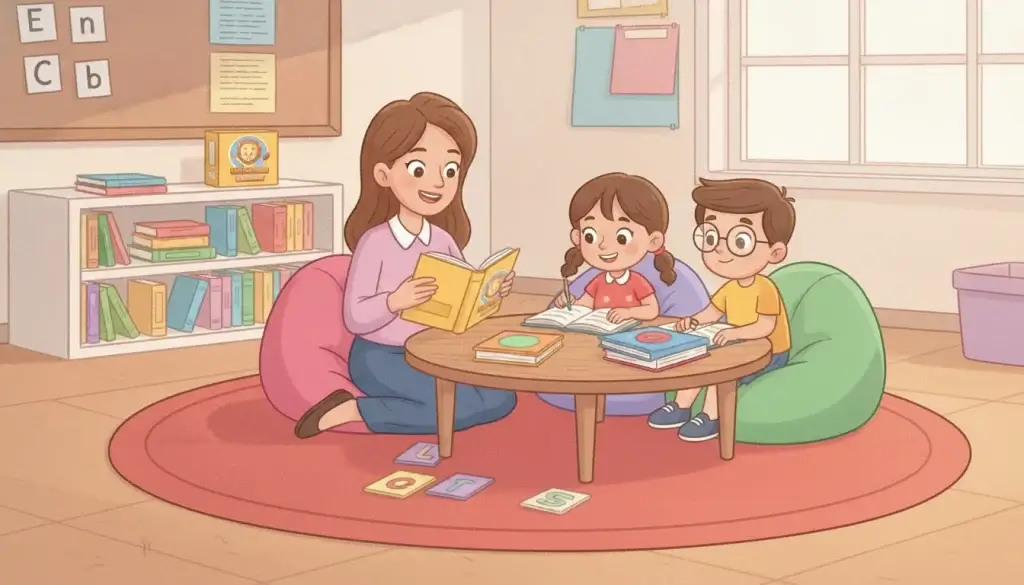
First graders need more than isolated word lists. They need a clear path from hearing sounds and matching them to letters, to reading words, sentences, and short texts with accuracy. The strongest routines make that path visible and repeatable.
Effective phonics activities for first grade combine explicit sound and spelling instruction, guided word practice, encoding, and connected decodable reading. Each activity should review known patterns, introduce a manageable new skill, and give students immediate practice applying it in words and text.
Browse our decodable books for first-grade practice
This approach supports both beginning readers who are building foundational skills and struggling readers who need additional modeling, practice, or smaller steps. It also keeps phonics connected to the purpose of reading: understanding what the words say. Start by organizing activities cumulatively, so each new task strengthens the skills students have already learned.
First graders need more than a collection of entertaining activities. They need a clear path from hearing sounds to reading and spelling words. A systematic sequence makes each lesson build on skills students have already practiced. It also gives teachers a practical way to identify the next useful step.
Start with one sound-spelling pattern and teach it directly. Model the sound, connect it to its grapheme, and blend it in words. Then ask students to read, spell, and write words using that pattern. Add a small amount of review from earlier lessons. This cumulative design helps students strengthen old learning while meeting a new challenge.
| Lesson phase | Teacher action | Student evidence |
|---|---|---|
| Hear the sound | Say the target phoneme and contrast it with a known sound. | Student identifies or manipulates the sound orally. |
| Map to print | Connect the phoneme to its grapheme or grapheme group. | Student points to the pattern and blends it in a word. |
| Practice and apply | Use word building, dictation, sentences, and decodable text. | Student reads, spells, rereads, and answers a meaning question. |
Research on first-grade intervention has examined a related group of foundation skills: letter-sound knowledge, phonemic awareness, decoding, and spelling. One study focused on these abilities for at-risk first graders, rather than treating reading as extended text exposure alone. Read the first-grade intervention study for its research details. Explicit instruction also has substantial research support for students at risk for reading difficulties. Review the research on explicit instruction.
The exact starting point should match the child. A beginning reader may first need short-vowel words and simple sound mapping. A struggling reader may need slower review of those same skills, with more modeling and guided practice. Neither student benefits from skipping directly to patterns they cannot yet use.
A practical progression can move from short vowels to digraphs and blends, then to long-vowel and more complex patterns. Little Lions materials describe this kind of systematic grapheme-phoneme sequence, with new learning built on prior skills. See the decodable book sequence.
Keep explicit practice and connected reading together, but do not confuse their purposes. Sound cards, word building, and dictation give students focused practice with a target pattern. Decodable sentences and stories then let them apply that knowledge without relying on pictures or guessing. Rereading controlled text supports accuracy and fluency. Ask one brief comprehension question afterward so reading remains connected to meaning.
Before moving on, check whether students can read the pattern in a new word and spell it from dictation. If they can, add the next pattern while continuing brief review. If they cannot, return to the sound, grapheme, and word routine with more support.
Before asking students to read a whole word, warm up the sound work that makes decoding possible. Keep the routine brief, oral first, and connected to the graphemes students will see. This gives beginning readers a clear entry point and gives struggling readers repeated practice without asking them to guess.
Say a word such as map. Ask, “What sound do you hear at the beginning?” Then ask for the middle and final sounds. Use a few words that share the lesson’s focus, such as mat, sit, or sun. Students can tap one finger for each sound or move a counter as they say it. Sound cards can support explicit phoneme practice, while word-family activities can help students notice what changes and what stays the same.
Stretch the sounds in a word without showing its letters: /m/ /a/ /p/. Have students blend them into map. Then manipulate one phoneme: “Change /m/ to /t/. What word do you hear?” Move from initial sounds to medial vowels and final sounds as students are ready. If a student cannot blend orally, slow down and repeat the sounds. Do not move to print simply because the group is on a schedule.
Use this short oral-to-print routine:
Review previously taught grapheme-phoneme correspondences before introducing a new pattern. A predictable, cumulative routine reinforces earlier skills while adding new learning. Use visual, auditory, and movement-based practice when helpful. For more oral practice ideas, see these phonemic awareness activities. Once students can connect the sounds to print, they are ready to build and read a small set of controlled words.
A repeatable word-building routine helps students connect speech sounds, letters, reading, and spelling. Use the same sequence often, but adjust the word pattern and support for each learner. A beginning reader may need counters and teacher modeling. A struggling reader may need fewer words, more repetition, and a clear review of previously taught correspondences.
Connected reading works best when students apply a recently taught pattern in a clear, supported sequence. The goal is not to make every word in every text perfectly controlled. Instead, choose text that gives students a strong opportunity to use the target pattern while keeping the reading meaningful.
Begin with a brief review of the grapheme-phoneme correspondence. Display the spelling pattern, say its sound, and have students identify it in two or three familiar words. The teacher might say, “This pattern represents /sh/. Find the pattern, say the sound, and tell me where you hear it.” Correct errors immediately, then ask students to blend the sounds again.
Place several words in a short list. Include words with the new pattern and a few words that review earlier learning. Ask students to read each word by looking through the word from left to right. If a student hesitates, prompt, “Look at the letters. Say the sounds, then blend.” Avoid directing the student to guess from a picture or sentence meaning.
Next, move to two or three decodable sentences. Read the first sentence together, then invite students to read it independently or with a partner. Ask them to reread any sentence that sounded choppy. The teacher checks whether students are reading the target words accurately and whether they can maintain meaning across the sentence.
Introduce a short decodable book that matches the current skill sequence. Preview only the genuinely new words students need to know before reading. Then let students read the book, offering prompts that return them to the print. Decodable stories provide controlled skill-level practice, and repeated reading can support accuracy and fluency.
Little Lions books include new-word lists, comprehension questions, and extension activities that help connect word-level practice with a complete reading experience. For practical follow-up ideas, try these activities with decodable books.
Use a second reading to build smoother phrasing, not speed alone. Ask one or two questions about the characters, setting, problem, or important information. Require students to point to or explain the part of the text that supports an answer. In a small group, this sequence can become guided reading with decodables, with prompts adjusted to each reader’s current skills.
First graders do not all need the same amount of modeling, practice, or text support. Keep the target sound-spelling pattern consistent, then adjust the pathway each student uses to reach accurate reading and spelling.
Use a small set of words that contains only the patterns already taught. Say the word, have the student tap or move one counter for each sound, and then match the sounds to graphemes. Build the word with tiles before asking the student to read it. Follow with one or two sentences in controlled text.
Keep the print visible and prompt the student to look through the word from left to right. If the student hesitates, return to the sound and spelling pattern rather than asking for a picture or context clue. A quick check is simple: Can the student read the word accurately, spell a related word from dictation, and use the pattern in a new sentence?
Reduce the number of new items and increase the number of accurate responses. Begin with a brief review of previously taught sound-spelling correspondences. Model one example, practice several words together, and then give each student a turn to read and spell. Use sound boxes, letter tiles, or oral sound manipulation to make the steps observable.
Small-group reading and differentiation are relevant teacher needs, and explicit practice can address letter-sound knowledge, phonemic awareness, decoding, and spelling together. One first-grade intervention study examined this combination with students at risk for reading difficulties, but classroom activities should not be treated as a diagnosis or a guaranteed outcome. Read the first-grade intervention study.
Check accuracy during the lesson. Note whether the student identifies each sound, blends without guessing, spells the word, and reads it again in a sentence. Reteach the smallest missing step, then offer another example.
Do not move straight to unrelated advanced content. Ask the student to read a wider set of words with the same pattern, spell selected words, and explain what stays consistent. Then provide a short decodable passage that uses the pattern in connected text. Ask the student to reread for smoother phrasing and answer a brief comprehension question.
This approach keeps differentiation tied to transfer. Beginning readers receive more modeling, struggling readers receive focused supported practice, and secure readers receive more application without abandoning explicit phonics.
Use this 10-15 minute routine as a flexible example for a classroom, small group, or homeschool setting. The timing is not a guarantee of mastery. Adjust the pace when a child needs more modeling, practice, or review.
Begin with a quick, explicit review of a previously taught sound-spelling pattern. Show two or three graphemes, say the sounds, and have the child respond. Then blend a few familiar words aloud. For example, review a short-vowel pattern before reading words that use it. Keep the focus narrow so the child can respond accurately.
Move from sound work to print. Ask the child to read several words with the target pattern, then spell one or two words from dictation. Use tiles, sound boxes, a whiteboard, or letter cards. Prompt the child to look at each grapheme and blend through the word. Do not encourage guessing from a picture or context.
Choose words that connect to previously taught skills. A beginning reader may need familiar CVC words and strong modeling. A struggling reader may need fewer words, slower blending, and immediate corrective feedback. A secure reader can read more words or explain the pattern.
After word practice, read a short decodable passage or book that provides controlled practice with the same skills. Preview only the new words that require support. Let the child decode the text instead of supplying words too quickly. A second reading can build accuracy and fluency because the child practices the same text again.
Use decodable books for first grade that match the reader’s current sequence. Connected reading should be part of the lesson, not a reward after phonics instruction.
Finish with one direct comprehension question. Ask the child to retell an event, identify a detail, or explain a character’s action. If the answer is unclear, return to the sentence or passage and reread it together. This final step keeps accurate word reading connected to understanding.
Teach one sound-spelling pattern at a time, then practice it in words, spelling, sentences, and a short decodable text. Review earlier patterns in every lesson so new learning builds on secure skills. Ask the child to read the word from the letters rather than guess from pictures or context.
Use sound boxes, letter tiles, word chains, and controlled sentence reading. For example, have the student build a word, change one sound or spelling pattern, read the new word, and write it from dictation. Finish with a decodable passage that contains the patterns being practiced.
Try a word-building relay, a sound sort, or a roll-and-read game. Keep the goal instructional: students should say the sounds, map them to graphemes, read the word, and explain or use it. Add movement or partner turns without replacing explicit practice.
Begin with a quick oral sound warm-up, such as identifying the first or final phoneme in a word. Follow with sound-card or grapheme review, then blend two or three familiar words. This short routine prepares students for focused word work and connected reading.
Skill-matched decodable books give first-grade readers a clear path from phonics practice to reading complete stories. Choose books that support the patterns your learners are working on, then use rereading to build accuracy and confidence.
Browse Little Lions Literacy decodable books and choose the next practice match.