Mastering three-letter words with short vowels is the first big win for a new reader. These patterns help children move from learning sounds to reading full sentences with confidence.
A CVC word list is a clear teaching tool that groups consonant-vowel-consonant words by their short vowel sound. These three-letter words, such as cat, bed, and sit, are the building blocks of early literacy because they follow simple phonetic rules without complex letter teams. By using a neat list, educators can help students practice blending sounds and segmenting words into single parts. This approach aligns with the Science of Reading by focusing on how children map sounds to letters to build strong word recognition skills. According to the Common Core State Standards, kindergarten students must learn to isolate and pronounce the initial, medial, and final sounds in these three-phoneme patterns. Using a simple set of examples allows early readers to see recurring word families. This builds the confidence they need to decode more difficult texts as they grow.
Teachers use these collections to plan their daily lessons and small group work. It helps to understand how these simple patterns fit into a complete phonics curriculum. We will start by looking at the basics in What Is a CVC Word List? The path to fluency begins here.
A CVC word list is a tool used to teach children how to read simple words. These words follow a set pattern of three letters. The first letter is a consonant. The middle letter is a vowel. The last letter is another consonant. This form makes them easy for young learners to sound out and blend. Teachers and parents use these lists to build a strong base for reading. Most lists start with common letter sounds to help kids succeed fast.
A CVC word list often groups words by their middle sounds. This helps kids see patterns in how letters work together. By learning these simple terms, students start to see more complex words later. This method is a key part of phonics lessons in schools and at home. It allows kids to move from learning single letter sounds to reading full words.
In a CVC word, the middle vowel usually makes its short sound. These short vowel sounds are the first ones children learn. Words like “cat,” “pig,” and “sun” are good examples. They allow kids to practice the basic sounds of each letter without tricky rules. Since the words are short, they do not overwhelm new readers.
Using a word list helps students focus on one vowel sound at a time. This focus builds their confidence as they learn to blend sounds into words. It also helps them hear the difference between similar sounds like the “a” in “bat” and the “o” in “bot.” Once a child learns one vowel group. They can move to the next one on the list. This steady progress is vital for early reading success.
CVC words are a big part of the plan for young students. They are mostly taught in kindergarten and the first months of first grade. These words help kids meet state standards for reading. For example, the CCSS.ELA-Literacy.RF.K.2d standard requires students to isolate sounds in three-letter words. This means they must say each sound in the word clearly.
When children work with these lists, they learn to hear each clear sound. They practice saying the first, middle, and last sounds of a word. This skill is called phonemic awareness. It is a vital step for both beginning and struggling readers. It helps the brain link sounds to the letters they see on a page. Learning these simple words leads to better reading and writing skills in the future.
Short A is often the first vowel sound students learn in phonics. A cvc word list for short A helps kids practice blending sounds into words. These words follow a simple pattern with a consonant, a short A, and a final consonant. This structure makes it easier for new readers to build their skills.
Teachers often use word families to organize these lists. Word families group words that share the same ending. This helps children recognize patterns and read more quickly. You can find more short A words for kids to use in your daily lessons.
The -at family is a great place to start. Words like bat, cat, fat, and hat are easy to rhyme. Students can swap the first sound to make a new word. For example, changing the “b” in bat to a “c” makes cat. This practice helps kids hear the small parts of each word.
The -an family adds more common words to a child’s list. You can teach words like can, fan, man, and pan. Kindergarten students must learn to isolate and pronounce each sound in these three-phoneme words. Using these lists helps them master this key skill.
Other words in these groups include:
The -ap family features words that kids often see in simple books. These include cap, gap, lap, and map. You can also teach nap, rap, sap, and tap. These words are fun to use in games where kids tap out each sound before blending them.
Next, move to the -ag family. This group includes bag, gag, nag, and rag. Words like tag and wag are also helpful for practice. These short A words help the brain connect letter shapes to sounds. This link is vital for long-term reading success.
There are many other short A groups to explore. The -ad family has bad, dad, had, and lad. You can also include mad, pad, and sad. These words often describe feelings or people, which makes them easy for kids to understand.
The -am and -ab families add even more variety. In the -am group, you will find jam, ham, ram, and yam. The -ab family features cab, dab, gab, and lab. Using these different families keeps lessons fresh and helps kids see how vowels work in many settings.
Other common families to check out include:
The short e sound, often heard at the start of the word “egg,” is a key part of any cvc word list. While this vowel group has fewer words than short a, it is vital for young readers to master. Children must learn to find and say the middle vowel sound in three-letter words to build strong reading skills. This skill helps them meet standards that focus on isolating phonemes in CVC words during kindergarten.
The -ed and -eg word families help children learn to blend the short e sound with final consonant stops. Words in these groups are often easy for kids to picture. This helps them make sense of what they read. Using these words in daily practice builds the sound skills needed to read with ease.
When teaching these families, ask students to change the first sound to make a new word. For example, changing the /b/ in “bed” to /r/ makes “red.” This simple task helps children understand how letters stand for specific short vowel sounds in print.
The -en and -et families have some of the most common words in early books. These words appear often in simple stories. This makes them great for building student trust. Because kids see words like “hen” and “pet” so much, they often become the first short e words they know by heart.
Teachers can use these lists to create word sorts. Sorting “hen,” “pen,” and “ten” by their last sound helps students spot patterns in English spelling. This work is a core part of phonics teaching for both new and struggling readers.
A few other short e words do not fit into large families but are still helpful to know. These words end in -eb or -em and help round out a child’s reading tools. While they are less common, they still follow the standard consonant-vowel-consonant pattern.
Teaching these words shows students that the short e sound stays the same, even when the final letter changes. This helps them move past simple rhyming and toward true decoding. Learning these small groups is one more step toward becoming a skilled reader.
The short I sound is one of the most common vowels in the English language. It appears in many simple words that children learn early in their reading journey. Teachers often group these words by their endings, which are called word families. This helps students spot patterns and read more quickly.
The -it and -in families are great places to start with a CVC word list. These sounds are clear and easy for most kids to hear. You can use these words to help students practice short vs long vowels during daily lessons.
Many short I words use the -ig, -ip, and -id patterns. These word families help kids build their “mental dictionary” of sounds and meanings. Research from academic sources shows that linking sounds to letters is a key step in reading growth. Using a clear list makes this task easier for both teachers and parents.
There are several smaller word families that use the short I sound. These include words ending in -ib, -im, and -ix. Even though these groups have fewer words, they are still useful for phonics practice. Students can learn to blend these sounds to gain more confidence with their short vowel sounds.
The -ish and -ick families add variety to short I practice. These patterns still follow the CVC rule but offer slightly more challenge for growing readers.
Short I is one of the most productive short vowels in English. To help students master it, use word sorts where children group short I words with short A words. This builds phonemic awareness and teaches them to listen for vowel differences. Blending drills with short I words also strengthen the connection between what students hear and what they see on the page. The best CVC word list is one that students can reference daily during independent reading time.
The short O sound is made by opening the mouth wide in a round shape. This “open-O” sound is clear and easy for kids to see and hear. Because the mouth shape is so clear, short O words are great for teaching phonemic awareness. Young readers can practice finding the middle sound in these simple words. Using a short vowel sounds list helps students build the skills they need to blend and segment.
The -ot word family is one of the most common groups for short O. These words end with the same sound, which helps kids spot patterns in their reading. Common words in this list include hot, cot, dot, got, lot, not, pot, rot, and tot. When students master one word in the family, they can often read the others by just changing the first letter.
The -og family is also helpful for new readers. Words like dog, fog, hog, jog, and log are easy to blend and know. School standards like CCSS.ELA-Literacy.RF.K.2d require students to find and say the sounds in three-phoneme words. Practice with these families gives kids a strong start with their decoding skills.
The -op word family includes many words that kids use every day. You can use words like cop, hop, mop, pop, and top to help students practice their mouth shapes. The “p” sound at the end needs a burst of air, which helps children feel the end of the word. This body cue is helpful for struggling readers who need support with phonemic awareness.
In the -ob family, you will find words like bob, cob, job, mob, rob, and sob. These words are great for blending practice. Teachers often use these lists to create word sorts or matching games. When kids see how these words share the same ending, they feel sure in their reading.
There are several other short O families that round out a full cvc word list. The -od family includes words like cod, god, nod, and rod. These words are simple but helpful for teaching letter-sound links. Students can also learn the -ox family with words like box and fox. Even though “x” has two sounds, it is taught as a single final sound in CVC patterns.
Other common short O words include mom, con, don, and son. While these do not always fit into large families, they are still important for kids to know. You can use these words to show how the short O sound stays the same even when the final consonant changes. Daily practice with these lists helps children become fluent and ready for more hard texts.
The short U vowel sound, pronounced /ŭ/ as in “cup,” is usually the last short vowel taught to beginning readers. This sequencing is intentional. Under the Science of Reading, we know that the short U sound can be tricky. Early readers often struggle to differentiate /ŭ/ from the short O sound (/ŏ/ as in “cop”) or the short E sound (/ĕ/ as in “beg”). Orthographic and phonological systems in the brain must work together to isolate and decode these highly similar sounds. Teaching short U after the other short vowels ensures students have a stable foundation in letter-sound correspondence before tackling this vowel contrast.
Organizing short U words into word families helps students identify spelling patterns and build automaticity. Read on for a comprehensive short U cvc word list, structured by word families to support systematic phonics instruction.
The -ut family is excellent for practicing rapid oral blending. Focus on isolating the initial consonant before blending it with the rime.
The nasal /n/ ending in the -un family can sometimes alter vowel perception slightly. Ensure students pronounce the crisp /ŭ/ sound clearly before the nasal consonant.
The voiced /g/ stop consonant at the end of the -ug family is highly satisfying for young readers to pronounce. Use these words for hands-on decoding games.
The bilabial /b/ sound helps students physically feel the stop consonant articulation at the end of each word.
The voiced alveolar stop /d/ in these words provides clean, clear target endings for phoneme isolation practice.
Ensure students fully close their lips to produce the /m/ sound at the end of these CVC words.
These final CVC words help round out your student’s short U reading repertoire, strengthening the brain’s orthographic processing system.
To help early readers build confidence, transition from word lists to visual matching activities. Providing images alongside written words strengthens the semantic processing system, linking spelling directly to meaning. Explore our collection of phonics books and decodable stories to see how structured, explicit instruction turns beginning readers into confident, fluent learners.
Effective reading development requires the brain to integrate complex neural pathways. Specifically, students must connect the phonological processing system (perceiving and producing sounds) with the orthographic processing system (recognizing and recalling letters). Consonant-Vowel-Consonant (CVC) word lists serve as an ideal tool to bridge these systems. By focusing on systematic, phonics-based methods aligned with the Science of Reading, teachers and parents can turn simple lists into powerful instructional routines.
Phonological awareness is the foundation of word recognition. Blending activities help early readers merge individual phonemes into whole words. For example, students slide their fingers under the letters /c/, /a/, and /t/ to blend them into “cat.” Conversely. Segmenting requires students to break a spoken word down into its individual sounds, which is a key milestone for spelling. Using structured CVC lists allows educators to consistently prompt students to isolate the initial, medial vowel, and final sounds in simple three-letter words.
Word mapping is a highly effective Science of Reading strategy that builds orthographic mapping in the brain. Instead of relying on rote memorization, students connect the speech sounds (phonemes) to the physical letters (graphemes). Instructors can use a physical grid or sound boxes. Students say a CVC word, count the individual sounds they hear, place a marker for each sound, and then write the corresponding letters in the boxes. This process builds permanent word-storage pathways, turning temporary decoding skills into fluent sight-word recognition.
Sorting CVC words helps children notice spelling patterns and make critical phonological connections. Educators can organize lists into word families based on their short vowel sounds or ending rimes, such as the “-at” or “-op” family. Students group written cards by their medial vowels or ending patterns. Sorting teaches early readers to recognize spelling structures, enabling them to quickly decode new, unfamiliar words that follow similar patterns.
Once students can blend simple three-letter words using memorized letter sounds and visual cues, they need to apply these skills to connected text. Decodable books contain a high percentage of phonetically regular words that match the phonics patterns students have already learned. Integrating CVC word lists with decodable books builds true reading fluency. Practicing words in isolation first gives children the confidence and decoding mechanics required to read sentences and short paragraphs successfully. For a deeper look at utilizing these patterns, explore our comprehensive CVC words guide.
A CVC word list is a structured collection of simple three-letter words that follow a consonant-vowel-consonant spelling pattern. In these words, the middle letter is always a short vowel. Educators and parents use a CVC word list to help early readers transition from letter-sound recognition to blending and decoding complete words.
CVC words are essential in early literacy because they allow children to practice blending three distinct sounds together without the complexity of long vowels. Silent letters, or consonant blends. Mastering these basic words builds phonemic awareness, boosts reading confidence, and forms the foundation for reading fluency under the Science of Reading framework.
For effective phonics instruction, CVC words should be organized systematically rather than randomly. Grouping words by their short vowel sound (such as short a or short o) or by word families (like the “at” family or the “ig” family) helps children recognize visual and phonetic patterns. Making it easier to decode new words.
Ten common examples of simple, easily decodable CVC words representing all five short vowel sounds include: cat, hat, bed, red, pig, sit, dog, hot, sun, and cup. These words are perfect for beginner blending practice because they are highly concrete and easy for young learners to visualize.
There are hundreds of CVC words in English. Most phonics programs focus on 100 to 150 core CVC words for kindergarten and first grade. These words cover all five short vowel sounds and the most common consonant sounds. Teachers introduce them gradually, starting with short A and building up to short U. A well-organized CVC word list makes it easy to track which words students have mastered and which ones they still need to practice.
Parents can practice CVC words at home using simple word cards, magnetic letters, or even a whiteboard. The key is to keep sessions short and focused. Start with 5 words from one word family, such as the -at family. Ask your child to say each sound, then blend the sounds together to read the full word. Once your child reads the word, have them write it down. This combination of hearing, saying, and writing helps lock the pattern into memory. Our decodable books are also a great tool for at-home CVC practice because they pair word lists with real stories kids can read.
Mastering CVC words requires systematic, hands-on practice. While word lists and digital activities are excellent starting points, nothing replaces the tactile experience of reading a physical book. Transitioning from isolated CVC word list practice to connected text builds true reading fluency and confidence in young learners.
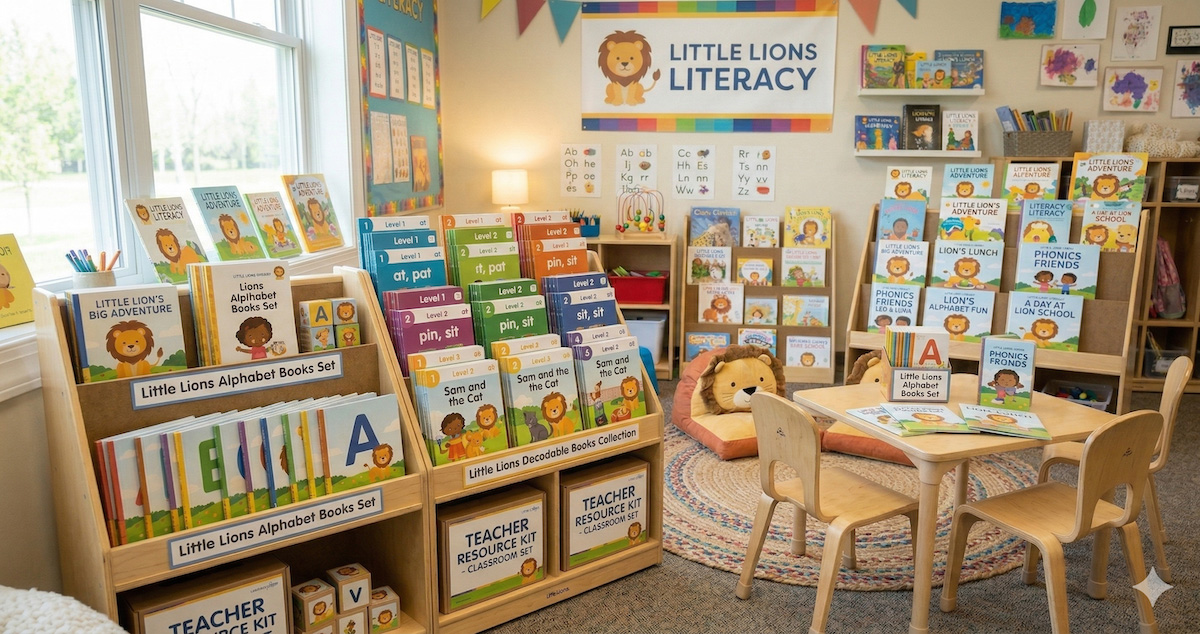
Little Lions Literacy offers beautifully illustrated, phonics-based decodable books for CVC practice designed specifically to support beginning and struggling readers. Whether you are a parent supporting learning at home or an educator equipping an entire school. You can explore our complete collection of decodable books, classroom sets, first readers, practice books, and teaching resources.
Start small with individual softcover books starting at just $8.50 to $9.99, or fully equip your school with comprehensive classroom kits up to $629. We provide free shipping on all orders of $75 or more, and offer a 30-day money-back guarantee on all individual books. Shop our collection online today to give your children the physical tools they need for reading success.