English relies on only five vowel letters to represent eighteen distinct vowel sounds. This mismatch creates a complex puzzle for students who must coordinate multiple cognitive processes to read fluently. Teachers need a planned way to bridge this gap for both new and struggling readers. Browse our collection of decodable books to find phonics resources that support vowel team instruction in your classroom.
Vowel teams are groups of two to four letters that represent a single vowel sound. They provide a vital workaround for the limited number of vowels in English. According to Voyager Sopris, these twenty-five standard patterns allow five basic vowels to represent eighteen distinct sounds. This requires educators to use explicit and planned instruction. When students learn how vowel pairs function, they can coordinate the cognitive processes needed to decode words correctly and build fluency for long-term reading success. This guide provides the practical scope and sequence that teachers and parents need to teach these spelling patterns using proven phonics methods.
A vowel team is a group of two, three, or four letters that work as one to make one vowel sound. In some cases, two vowels sit next to each other to make a long sound, like the “ai” in “rain” or the “ee” in “feet.” In other cases. A mix of vowels and consonants work as a unit. Such as the “eigh” in “eight.” These teams are key tools for kids who are learning to read and spell.
Think of these letters as a team on a sports field. When kids learn to spot these teams, they stop trying to sound out every single letter. This helps them move from slow decoding to a much smoother reading pace.
English has a tricky spelling system. Our language uses 18 unique vowel sounds, but we only have five vowel letters. Vowel teams help bridge this gap by creating more ways to show these sounds in print. Without teams, we would not have enough letter combinations to show every sound we use when we speak.
Using these patterns helps children master the alphabetic code so they can read with more speed and ease. Since there are so many sounds and so few letters, these patterns are a must for fluent reading. They allow readers to group letters together instead of looking at each one on its own. This makes it much easier for the brain to process long or unfamiliar words.
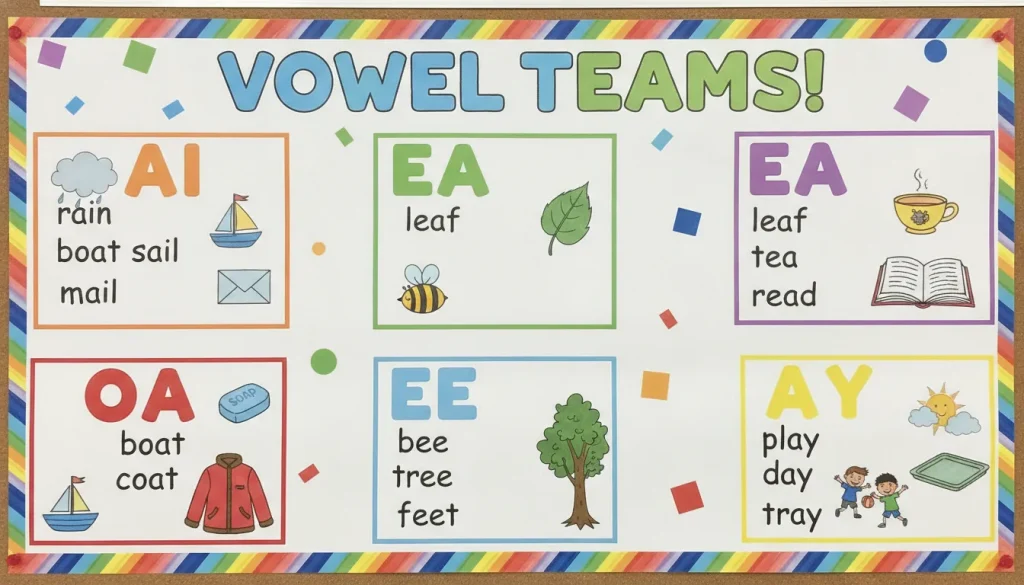
Most teams use two vowels to create one long sound. Common pairs include ee in feet, oa in boat, ay in play, ie in tie, and ea in sea. These groups act as single blocks that guide the reader through a word.
Some teams use more than two letters. The team “igh” in the word “light” uses three letters for a long /i/ sound. Other teams can have four letters, such as “eigh” in “eight.” Knowing these patterns helps kids spot letter combinations quickly. This skill is a big step for both new readers and those who may struggle with phonics.
You may hear teachers use the term vowel digraphs when talking about these patterns. A digraph is a set of two letters that make one sound. While many vowel teams are digraphs, some teams use more than two letters. Understanding the distinction helps teachers pick the right tools for their lessons.
Learning how these units work is a big part of phonics. It helps kids see that letters do not always work alone. When they spot a team, they know to blend the letters into one clear sound. At Little Lions Literacy, we design our decodable books around these exact phonics patterns to give students targeted practice with vowel teams.
Many teachers and parents wonder about the difference between diphthongs and vowel teams. Both terms describe how letters work together to make sounds. A vowel team is a group of two to four letters that make one vowel sound. A diphthong is a specific type of vowel team where two vowel sounds glide together in a single syllable. All diphthongs are vowel teams, but not all vowel teams are diphthongs.
Vowel teams make one steady vowel sound using two to four letters. Diphthongs are a subset of vowel teams where the sound shifts as you say it. English has about 25 standard vowel teams and exactly 8 diphthongs. Teaching this distinction helps students decode both steady vowel sounds and gliding sounds with confidence.
A standard vowel team makes one steady sound. In the word “rain,” the letters “ai” work as a team to make the long “a” sound. The mouth stays in one place while you say it. Little Lions Literacy resources help students map these sounds to the vowel digraphs they see on the page.
Diphthongs work differently because the sound changes as you say it. Your mouth starts in one position and moves to another. Think of the word “boy.” When you say “oy,” your lips shift from a round shape to a flatter one. There are 8 English diphthongs in total, including common pairs like “oi,” “oy,” “ou,” and “ow.”
Learning these patterns is a key part of basic phonics skills for young readers. English spelling is often complex, and students must recognize these various patterns to read well. This step is vital for helping children master the alphabetic code, following research from the National Institute of Child Health and Human Development. The table below compares these two concepts side by side.
| Feature | Vowel Team | Diphthong |
|---|---|---|
| Definition | 2-4 letters making one sound | Two sounds gliding together |
| Sound Pattern | One steady vowel sound | A shifting or sliding sound |
| Examples | rain, feet, boat, eight | coin, loud, boy, cow |
| Number in English | About 25 common teams | Exactly 8 unique sounds |
| Teaching Approach | Focus on steady long vowels | Focus on the mouth’s movement |
When you start teaching these sounds, keep your lessons simple and clear. Begin with vowel teams that make a long vowel sound, like “ee” or “oa.” These are usually easier for children to hear. You can find effective strategies for teaching vowel teams that use hands-on tools to help kids remember the letter combinations. For diphthongs, ask students to feel how their mouth moves. Using a mirror can help them see the glide between the two sounds.
Wait until a child is confident with basic vowel sounds before introducing more complex teams. Phonics works best when it builds on what the student already knows. Using decodable books from Little Lions Literacy gives kids practice with these new patterns in real stories. Explore our decodable books for targeted vowel team practice.
Learning vowel teams is a key step in phonics. There are about 25 standard vowel digraphs that kids must learn. English has 18 vowel sounds but only 5 vowel letters, so these teams help represent complex sounds. Most teams use two letters, but some use up to four, like eigh in eight.
Vowel teams are organized by the sound they produce. Long vowel teams include ai, ay, ee, ea, ie, igh, oa, oe, ow, ue, ui, and ew. Diphthong teams include oi, oy, ou, and ow. Other patterns include oo (long and short), au, and aw. Teachers at Little Lions Literacy group teams by sound type for systematic instruction.
Many vowel teams stand for long vowel sounds. These patterns are vital for new readers and struggling readers who need clear support. Teachers often group these teams by the sound they make. This helps kids build strong connections between letters and sounds.
Other teams make unique sounds or diphthongs. Using books for teaching vowel teams helps kids see these patterns in real stories. Practicing these in decodable books builds reading speed and skill.
Teaching students to read words with multiple vowel patterns needs a clear plan. You should use systematic phonics instruction to introduce these patterns. This means you follow a set path that moves from easy to hard. A good order helps both new and struggling readers build a strong foundation for reading success.
The best sequence starts with simple long vowel teams like ai, ay, ee, ea, and oa. Next, introduce other long vowel teams like ie, igh, and oe. Then teach teams with multiple sounds, followed by diphthongs. Rare vowel teams like ue, ui, ew, au, and aw come last. Little Lions Literacy follows this scope and sequence in their decodable book sets.
The best first step is to teach teams that most often make the same sound. These long vowel teams are the most common in early books for kids. When you teach them one by one, children can learn each sound well before moving on. This builds their confidence as they start to read more complex words.
Once students know the easy pairs, you can move to teams with more than one sound. Some pairs like “ea” can be tricky because they sound different in “bread” and “eat.” You can find tips on teaching ee and ea phonics to help students learn these variations. After this, you should teach rare patterns to complete their knowledge.
Following this sequence makes sure your how to teach vowel teams approach works well. It gives kids a systematic way to handle the complex parts of English spelling. This step-by-step path is a key part of the science of reading for all students at Little Lions Literacy.
Explicit phonics instruction helps students master complex reading patterns. This systematic approach ensures that both new and struggling readers build a strong foundation. Using how to teach vowel teams as your guide, you can follow these steps to help your students succeed.
An effective vowel team lesson has six steps: introduce the team and its sound. Model decoding, lead guided practice with word lists, apply with decodable text, practice spelling, and spiral review. Little Lions Literacy recommends using decodable books at each stage to reinforce the specific patterns being taught.
Teachers often use two main approaches to teach phonics. Synthetic phonics helps children convert letters into sounds and blend them into words. This method is common in systematic phonics programs used today. Analytic phonics involves students identifying letter-sound patterns after seeing a whole word. Both approaches help children learn how to read and spell.
Good teaching moves from simple steps to more complex tasks. Start by showing the team and then move to reading whole books. This progression helps all students, including those who find reading challenging at first. For more tips, explore effective strategies for teaching vowel teams to use in your classroom.
Each child learns at a different pace, but systematic phonics instruction helps both new readers and those who find reading challenging. The goal for all students is to master the alphabetic code so they can read and understand new text. By matching your teaching style to the needs of each child, you can make vowel teams easier to learn.
New readers benefit from focusing on one vowel team at a time with plenty of decodable book practice. Struggling readers need multisensory approaches like magnetic letters, skywriting, and sorting activities. Both groups need systematic, sequential instruction. Little Lions Literacy decodable books support both beginning and struggling readers with targeted phonics practice.
For kids just starting out, keep things simple. Focus on one vowel team at a time to avoid confusion. Give them many chances to see the same pattern in different words. Use books that focus on the specific sounds you teach. These books for teaching vowel teams let kids practice their new skills in a way that builds confidence.
Daily practice is key for new readers. Start with simple words and move to harder ones as they improve. Make sure they have a good grasp of long and short vowels before moving on to complex teams. This strong foundation makes it easier for them to learn how two vowels can work together to make one sound.
Some children need more support to grasp phonics patterns. For these students, use multisensory tools to make the lesson more engaging. Have them use magnetic letters to build words or try skywriting to feel the shapes of the letters. These activities help the brain link the visual appearance of letters to the sounds they represent. Sorting tasks where they group words by vowel sound can also help them recognize patterns.
Repetition is vital for kids who struggle with reading. They often need to see and say a word many times before it sticks. Keep your lessons short but frequent. Give them extra time to work with decodable text until they feel confident. Using multiple senses helps them build deeper memory pathways. When they can touch, see, and manipulate letters, the sounds start to make more sense. Shop our decodable book sets designed specifically for systematic phonics practice.
Yes, vowel teams can have more than two letters. While many common teams like “ai” and “oa” use two vowels, others use up to four letters to create a single sound. For example, the team “eigh” in words like “eight” or “weight” uses four letters to make the long “a” sound. According to Voyager Sopris, these patterns are important for students to learn as they move toward more advanced reading.
No, vowel teams do not always make long vowel sounds. While many teams produce long sounds, some create unique sounds or short vowel sounds. The team oo can make the long sound heard in moon or the short sound heard in foot. Others like ea can make a short e sound in words like bread. Teaching students this fact is an important part of systematic phonics instruction.
Most children begin learning vowel teams in late first grade or second grade. Students should first master basic letter sounds and short vowels in simple words and common digraphs like “sh” or “ch.” Once a child can blend these sounds well. They are ready for the more complex patterns found in vowel teams. Research from the NICHD shows that explicit instruction at this stage builds reading skills for both new and struggling readers.
Vowel teams and vowel digraphs are very similar, but “vowel team” is a broader term. A vowel digraph refers to two vowels that make one sound, like “ai” in “rain.” A vowel team can include up to four letters. Such as “eigh” in “eight.” Both terms describe groups of letters that work together to make one vowel sound. Knowing these terms helps teachers use systematic phonics to help children read new and unfamiliar words.
Many students struggle to learn vowel teams because they do not get the targeted practice needed to connect letter patterns to their sounds. When children miss these key skills, they often fall behind their peers and lose confidence in reading as the books they encounter get harder. You can break this cycle by giving your learners the right tools and books that make these phonics patterns easy to grasp.
Browse our collection of decodable books and find the perfect practice tools for your classroom today.