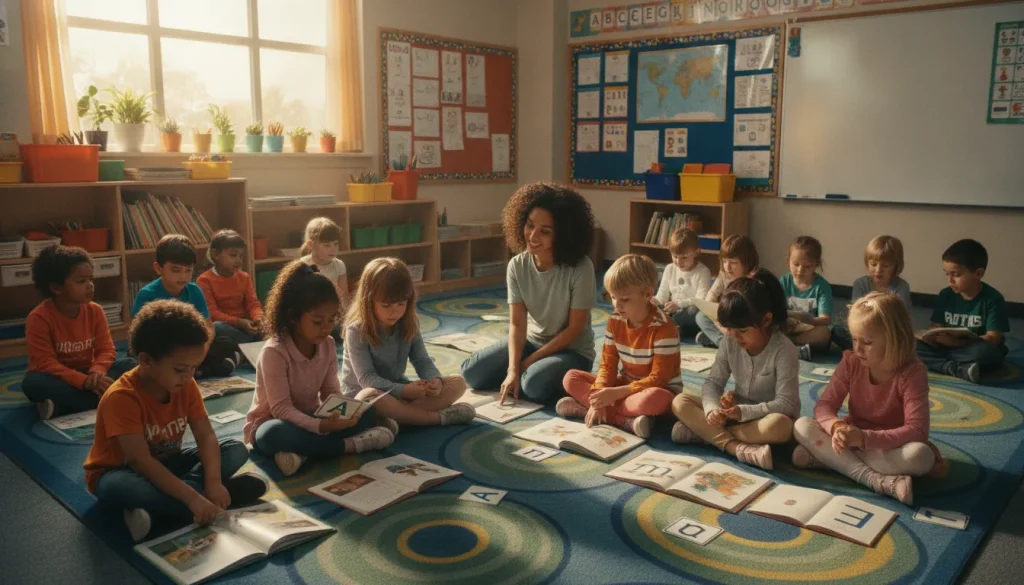
Children do not learn to read through exposure alone because the human brain is not wired for literacy. Thousands of studies now confirm that every child needs direct teaching to bridge the gap between sounds and letters.
What is the science of reading is a body of evidence from five decades of research in cognitive psychology that explains how people learn to read. This research base includes thousands of studies across the world and proves that reading is a complex cognitive process that is not natural for humans. According to The Reading League, students must be explicitly taught how to connect speech sounds to written letters through systematic and direct instruction. By applying these findings, schools can use systematic methods that ensure every student gets the specific instruction needed to become a fluent and confident reader. This evidence-based approach works for all students, including beginning readers and those who struggle with foundational literacy skills like phonics and phonemic awareness.
Understanding these scientific principles is the first step toward improving literacy results for all children. The sections below will define the science of reading, break down its five core components, and explain how to apply these findings in classrooms and at home.
The science of reading is the converging evidence from thousands of studies over five decades. It comes from fields like cognitive psychology and communication sciences. This body of research explains how people learn to read and why some children struggle. It is not a trend or a single program but a deep base of knowledge that informs evidence-based reading instruction for all students.
This research has been conducted across the world in many languages. It includes thousands of studies that show how the human brain processes written language. The Reading League notes that this evidence has grown for over 50 years. This long history ensures that the findings are stable and reliable for schools to use in their classrooms today.
In the late 1990s, Congress asked for a review of reading research. This led to the National Reading Panel. The group reviewed decades of work to find the best ways to teach reading. According to the National Institutes of Health (NIH), the panel helped find the most effective teaching methods. Their report remains a key source for modern reading instruction in schools across the country.
One core finding is that learning to read is not a natural process like learning to speak. Instead, reading is a complex cognitive task that the brain must learn. Most children need explicit instruction to build the paths in the brain required for reading. Research shows that teachers must provide direct and systematic help to ensure students become strong readers. This fact makes clear why high-quality, research-based tools are so helpful for early literacy success.
The National Reading Panel set out five core parts of reading in the late 1990s. These pillars give a clear map for how children learn to read and write. Research shows that systematic teaching in these five pillars is the best way to help most children.
The researchers behind the science of reading help teachers use this proven model. By focusing on each area, schools help both new readers and those who struggle. This plan ensures that no child is left to guess at the meaning of a text.
Phonemic awareness is the knowing that spoken words are made of single sounds. These small units of sound are called phonemes. Before a child starts to read print, they must be able to hear and work with these sounds.
For instance, they might blend sounds to make a word or break a word into its parts. This skill is a vital base for all later reading success. It does not use letters or print but focuses on the speech sounds that build our talk.
Phonics links the sounds we hear to the letters we see in writing. This key pillar helps children turn written marks into spoken talk. Good evidence-based reading instruction teaches phonics in a set and clear order.
This path usually starts with simple letter sounds and moves to hard patterns. Children learn how to blend letters to read words and how to spell them as they write. This plan helps students read new words without using picture cues or guessing.
Fluency is the skill to read text well and quickly. It also means reading with the right tone and feeling. When a child reads with fluency, they do not have to work hard to sound out every single word.
This ease of reading serves as a bridge between decoding and making sense of a text. If a student spends too much time on sounding out words, they cannot focus on the story. Fluency lets the brain shift its work toward the meaning of the words.
Vocabulary means the words a person knows and can use. This includes oral talk and knowing the meaning of written words in context. Students must have a strong bank of words to know what they read.
This knowledge grows through direct teaching and by reading many types of books. A student might learn a word by hearing it in a story or by seeing how it is used. Having a wide vocabulary is needed for deep success in school.
Comprehension is the final goal of reading. It is the skill to understand and get meaning from what is read. This process is not simple and requires lots of practice.
It needs the use of phonemic awareness, phonics, fluency, and vocabulary. To understand a text well, a reader needs facts they already know and active ways of thinking. When a child can use all five pillars at once, they become a strong and skilled reader.
The Simple View of Reading is a key model used to explain how people learn to read. It was first proposed by researchers Philip Gough and William Tunmer. This model shows that reading is not just one skill. Instead, it is the result of two main parts working together. Those two parts are decoding and language comprehension. Experts use a simple formula to show this: Reading Comprehension = Decoding x Language Comprehension.
In this formula, reading comprehension is the product of the two other skills. If a student is very weak in one area, their overall reading ability will suffer. For example, if a child cannot decode words at all, their score for decoding is zero. Even if they understand spoken language perfectly, their reading comprehension score will still be zero. This model highlights why students need both skills to succeed. It is a key part of the Structured Literacy approach.
Decoding is the ability to turn written letters into spoken sounds. This process is often called word recognition. Research from the National Institutes of Health shows that fast word recognition is needed for deep comprehension. When children can decode quickly, they do not have to spend all their mental energy on sounding out words. This lets them focus on the meaning of the text. Teaching phonics in a clear and systematic way helps students build these vital decoding skills.
Some students can read every word on a page perfectly but still do not understand what they read. This is often due to a gap in language comprehension. Language comprehension is the ability to understand spoken words and sentences. It includes things like vocabulary and background knowledge. If a child does not know the meaning of the words they are decoding, they cannot make sense of the story. The Science of Reading suggests that we must build both decoding skills and language knowledge to create strong readers.
For decades, schools used a model called balanced literacy. This method assumes that kids learn to read through a mix of phonics and exposure to books. While it aims for a middle ground, research shows that many kids struggle when they do not get clear, step-by-step help. In contrast, the science of reading uses evidence-based reading instruction to ensure every child learns to map sounds to letters.
The main gap lies in how teachers present new skills. A balanced literacy approach may not teach decoding skills as systematically as other methods. Instead, it often relies on kids to find the rules on their own. The science of reading moves away from this by using a Structured Literacy approach. In this model, teachers follow a set path to build skills from simple to complex.
Another big change is how kids handle words they do not know. Older methods often teach kids to look at a picture and guess the word. They might look at the first letter and then try to fit a word to the story. Scientific research from the National Institutes of Health shows that good teaching moves away from guessing in favor of sound-based decoding. This ensures kids read the words on the page rather than just look for clues.
| Feature | Balanced Literacy | Science of Reading |
|---|---|---|
| Phonics Role | Incidental or basic | Explicit and systematic |
| Word Reading | Multi-cueing (guessing) | Sound-based decoding |
| Teacher Role | Guide or helper | Direct instructor |
| Student Path | Discovery and immersion | Skill-based mastery |
| Research Base | Theory-based | Evidence-based science |
The science of reading is for every child. It works for students from all backgrounds and skill levels. Teachers play a key role in this process by giving direct, clear teaching based on proof. These methods help children build strong reading skills from the start in any setting.
One core part of this work is evidence-based reading instruction. This path focuses on teaching skills in a way that is well-planned and steady. It ensures that students do not have to guess how to read. Instead, they get the tools they need to decode words with trust.
Phonics teaching must be clear and direct. This is known as explicit instruction. It means teachers show students exactly how letters and sounds work together. This removes the need for students to guess rules on their own. Such guessing can be hard for many new readers.
To support this, students need the right books. Decodable texts are built to match a specific phonics plan. They let children practice the sounds they just learned in class. This builds success and helps them move from simple words to more complex lines over time.
Using these texts also stops children from using picture cues. Research shows that decoding sounds is a better way to learn than guessing. When children use phonics to read, they build the brain paths needed for growth. This approach creates a solid base for all future learning.
Finding reading gaps early is vital. Schools use proven tests to check how each student is doing. This helps find children who may need extra help right away. Early help can stop small gaps from becoming big hurdles later in a child’s life.
Checking progress is not a one-time event. It is a steady part of teaching. Teachers use data to change how they teach. If a student finds a sound or rule hard, the teacher can provide more practice. This keeps every child on the right track as they grow.
Extra help should be just as direct as the main lesson. Struggling readers often need more time with core skills like phonemic awareness. By giving them focused help, we ensure they do not fall behind. This inclusive model makes sure that no child is left to struggle alone.
Parents and guides can use these same ideas at home. You do not need a full classroom to help a child learn to read. Simple acts like reading decodable books together can make a big difference. Focus on the sounds in words and help your child blend them together.
It also helps to talk about what you read. Building a large vocabulary is a key part of the process. Even before a child can read, hearing rich language helps their brain prepare for future success. This home support builds on the work done in schools.
Daily work is the best tool for home learning. Short, daily practice sessions are better than long, rare ones. By making reading a part of your daily life, you show your child that it is both fun and useful. This bond helps them become life-long learners and strong readers.
The science of reading is the broad body of research that explains how humans learn to read. Structured literacy is the specific way teachers use that research in the classroom. According to The Reading League, structured literacy involves explicit and systematic instruction. This means teachers show students exactly how to link sounds to letters instead of letting them guess based on context.
No single person or group created this body of work. It comes from thousands of studies done over five decades across the globe. Experts in fields like cognitive psychology and communication sciences have all added to this evidence. Data from The Reading League shows that these findings apply to many different languages. It is a shared set of facts about how our brains process written words.
Evidence shows that this approach helps all students, including those who struggle to read in older grades. Research from The Reading League highlights that early identification and intervention are key to success. By using direct and clear instruction, teachers can help any child gain the skills they need. This method works for students from all types of backgrounds and levels of skill.
Decodable books are a vital tool for phonics practice. These texts use specific sounds and letters that a child has already learned in class. This helps students practice their skills without having to guess new words. According to The Reading League, these books align with a planned path of instruction. They give young readers a safe way to build speed and accuracy as they grow.
Decodable books are one of the most effective tools for applying the science of reading in your classroom or home. Little Lions Literacy offers a full collection of decodable books and phonics resources built on evidence-based practices. Every book supports explicit, systematic phonics instruction aligned with the science of reading.
Shop our collection of decodable books and phonics resources to give your students the targeted practice they need to become confident, fluent readers.