Did you know vowels can “say their names”? Many children find long vowels tricky—but mastering them unlocks confident reading and spelling.
Words like cake, rain, and play all share the same long “a” sound, even though they’re spelled differently. These patterns reveal the fascinating logic behind English phonics!
Imagine your child easily spotting long vowel patterns like silent “e,” vowel teams, or “y” endings—and reading new words with ease. With the right guidance, long vowels become a fun puzzle instead of a challenge.
In this guide, you’ll discover simple ways to teach long vowel sounds using clear examples, playful activities, and proven strategies. Start today and help your learner build a strong foundation for fluent reading and confident spelling.
A long vowel is a vowel sound that is pronounced exactly like the name of the letter itself. For example, in “cake,” the a says its name /ā/. This is one of the most important rules in long vowels phonics instruction.
The silent e at the end of the word bake is what makes the a say its name. The silent e jumps over the consonant and makes the vowel say its own name. This is a key pattern when teaching that a long vowel says its name. Some more examples are:
• A: cat (/a/) vs. cake (/ā/)
• E: bed (/e/) vs. bee (/ē/)
• I: sit (/i/) vs. bike (/ī/)
• O: dog (/o/) vs. boat (/ō/)
• U: cup (/u/) vs. cube (/ū/)
Long vowels should be taught after your learner is comfortable reading words with phonics short vowel sounds in CVC words (bat, run, hit, set, mop). Once your learner has mastered reading words with the short vowel sounds, they can begin to learn the long vowel sounds. This is also when students will start recognizing that the long vowel says its name.

Long vowels are often confused with short vowels, but these two phonics skills are completely different.
We usually teach phonics short vowel sounds first. This is because the short vowels are easier to read since they only have one spelling. They are also more common in beginning long vowels reading books and decodable books.
Long vowels can be represented by a variety of spellings, including silent e, vowel teams, and open syllables.
When a long vowel says its name, it means the vowel sound is the same as the letter name. For example, the “a” in cake sounds like the letter A. The “i” in ride sounds like the letter I.
This rule helps learners decode unfamiliar words more easily. It’s one of the first things taught in long vowels phonics. It also sets the stage for understanding vowel teams and more advanced spelling patterns.
1. Silent E: The ‘e’ jumps over a consonant to make the vowel say its name (e.g., bake).
2. Vowel Teams: Two vowels work together; the first one does the talking (e.g., rain, boat).
3. Open Syllables: A vowel at the end of a syllable is usually long (e.g., be, go, me).
4. Two Consonants: ‘I’ or ‘O’ can be long before two consonants (e.g., kind, gold).
Understanding long vowels helps children become stronger readers and spellers. When kids learn long vowel sounds, they begin to decode words more easily. Decoding means breaking a word into parts and matching letters to sounds. For example, knowing that the “a” in cake sounds like its name helps a child read and spell correctly.
At Little Lion Literacy, we’ve seen how mastering long vowels builds confidence. Children start to recognize spelling patterns and word families faster. This awareness makes it easier for them to read new words and write with accuracy.
Long vowel instruction also supports phonemic awareness, a key part of early literacy. When children hear and understand vowel patterns, they strengthen the link between letters, sounds, and meaning. Over time, they read smoother, spell better, and understand text with greater ease.
Teachers and parents who focus on long vowel practice see steady reading growth. Simple, fun activities—like word games or vowel charts—turn lessons into lasting skills. With expert guidance from Little Lion Literacy, every child can enjoy learning, feel capable, and build a strong foundation for lifelong reading success.
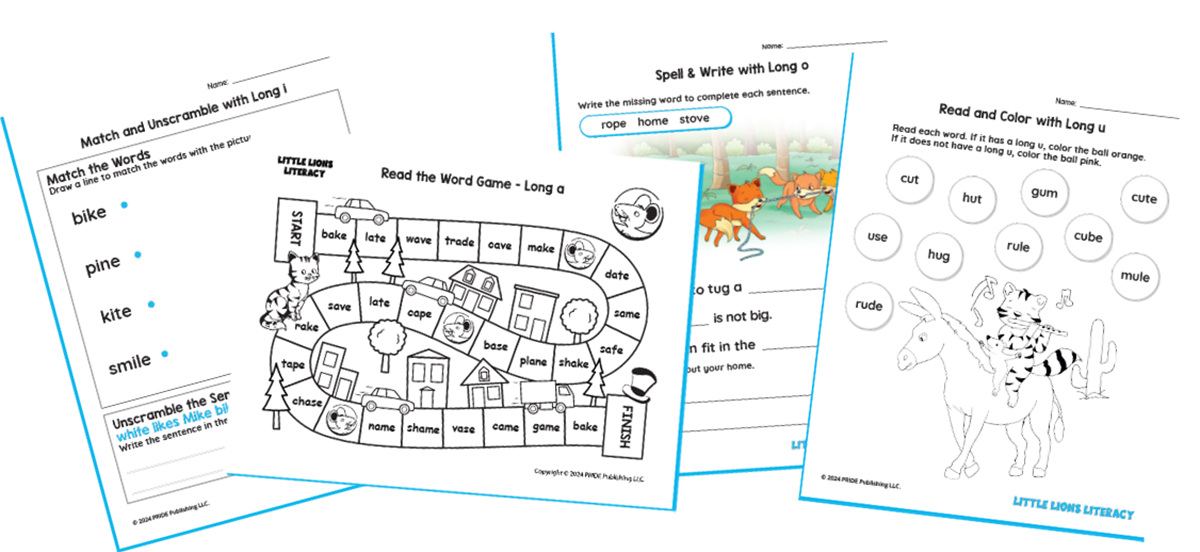
The best way to practice reading words and sentences with a new phonics concept is through fun and engaging learning activities. At Little Lions Literacy, we have a fantastic selection of resources, including a free downloadable board games and worksheets, to help your learner practice long vowel sounds in an exciting way!
Thank you so much for reading this post today. You might also be interested in reading our previous posts:
What is a Consonant Blend in Phonics?
All About Phonemic Awareness: A Guide for Parents and Teachers
Take a look at our decodable books. Your learner will get a lot of practice reading words and sentences with the consonant blends and answering comprehension questions. There are also extension activities listed at the end of each book.
Long vowels are vowel sounds where the vowel says its name. These sounds happen in words like cake, bike, home, and cute. For example:
Teaching that a long vowel says its name is a key part of long vowels phonics instruction.
A long vowel word is any word where the vowel says its name. In the word bake, the “a” says its name because of the silent e at the end. Other examples of long vowel words include made, ride, home, and cube.
The main difference is that a long vowel says its name, while a short vowel makes a different sound. In the word cake, the letter a says “A” that’s a long vowel. In the word cat, the a makes the /a/ sound that’s a short vowel. Students usually learn phonics short vowel sounds before long vowels.
The rule is: when a word has a silent e at the end, the long vowel says its name. For example, in mule, the silent e makes the u say “you.” This rule is one of the first patterns students learn when studying long vowels phonics.
While most words need vowels to work, there are a few long words with no traditional vowels (a, e, i, o, u), like rhythms. However, these are not common in phonics reading for beginners and do not follow long vowels or short vowel rules.
Is a dog a long or short vowel?
The word dog uses a short vowel sound. The “o” in dog makes the /o/ sound, which is one of the phonics short vowel sounds. It’s not a long vowel because the vowel does not say its name.


Share via: