Your child has mastered consonant digraphs like sh, ch, and th. Now it is time for the next step: trigraphs. These three-letter combinations are a natural progression in phonics, and understanding them helps children decode hundreds of new words with confidence.
In this guide, you will learn exactly what trigraphs are, how they differ from digraphs and consonant blends, which trigraphs to teach first, and how to practice them through word lists and hands-on activities.
Key takeaways:
A trigraph is a group of three letters that combine to make one sound (phoneme). The word comes from the Greek roots tri (three) and graph (written). Just as a digraph uses two letters to represent one sound, a trigraph uses three.
For example, in the word catch, the letters t-c-h work together to produce the single /ch/ sound. You do not hear the t separately. All three letters function as one unit.
Trigraphs can be made up of consonants, vowels, or a mix of both:
Understanding trigraphs is an important milestone in phonics because it teaches children that the relationship between letters and sounds is not always one-to-one. This concept builds phonemic awareness and supports both reading fluency and spelling accuracy.
English has roughly 17 trigraphs, though some appear far more frequently than others. Here are the ones your child is most likely to encounter in early reading.
tch — makes the /ch/ sound
The trigraph tch appears at the end of words, typically after a short vowel. It makes the same sound as the digraph ch, but the spelling rule determines which one to use.
| tch Words | ||
|---|---|---|
| batch | catch | ditch |
| fetch | hatch | hutch |
| kitchen | latch | match |
| notch | patch | pitch |
| scratch | sketch | snatch |
| stitch | stretch | switch |
| thatch | watch | witch |
The tch rule: Use tch to spell the /ch/ sound immediately after a short vowel in a one-syllable word. Use ch in most other positions (beginning of words, after consonants, or after long vowels). Exceptions include much, rich, such, and which.
dge — makes the /j/ sound
The trigraph dge appears at the end of words after a short vowel and makes the same sound as the letter j or the digraph ge.
| dge Words | ||
|---|---|---|
| badge | bridge | budge |
| dodge | edge | fridge |
| fudge | grudge | hedge |
| judge | ledge | lodge |
| nudge | pledge | ridge |
| smudge | trudge | wedge |
The dge rule: Use dge to spell the /j/ sound immediately after a short vowel. Use ge after a long vowel or consonant (e.g., huge, change).
igh — makes the long /i/ sound
The trigraph igh is one of the most common ways to spell the long /i/ sound, especially in one-syllable words.
| igh Words | ||
|---|---|---|
| bright | fight | flight |
| fright | high | knight |
| light | might | night |
| right | sight | sigh |
| slight | thigh | tight |
Other trigraphs your child may encounter:
| Trigraph | Sound | Example Words |
|---|---|---|
| air | /air/ | chair, fair, hair, stair |
| ear | /ear/ | hear, near, dear, clear |
| ear | /ur/ | earth, learn, pearl, heard |
| ore | /or/ | more, store, chore, bore |
| are | /air/ | care, bare, share, stare |
| eer | /ear/ | cheer, deer, steer, beer |
| our | /or/ | four, pour, your, course |
| oul | /oo/ | could, should, would |
| ure | /yoor/ | cure, pure, sure, lure |
Notice that some trigraphs can represent more than one sound. The trigraph ear, for example, says /ear/ in hear but /ur/ in learn. Context and practice help children learn which pronunciation to use.
Since trigraphs build directly on digraph knowledge, it helps to understand how they compare. If your child already knows the difference between blends and digraphs, this next step will feel familiar.
| Feature | Digraph | Trigraph |
|---|---|---|
| Number of letters | 2 | 3 |
| Number of sounds | 1 | 1 |
| Examples | sh, ch, th, ck, ee, oa | tch, dge, igh, ear, air |
| When taught | After CVC words | After digraphs |
The key similarity is that both digraphs and trigraphs represent a single sound. The only difference is the number of letters involved. A child who can read ch in much is ready to learn that tch in match makes the same /ch/ sound with an extra letter.
Think of it this way: digraphs are two-letter teams, and trigraphs are three-letter teams. Both create one sound, and both need to be recognized as a single unit when reading.
Trigraphs fit into the phonics scope and sequence after your child has mastered:
Most phonics programs introduce trigraphs in late first grade or early second grade, though readiness varies from child to child.
Recommended teaching order for trigraphs:
Since there are only two common consonant trigraphs (tch and dge), most teachers cover both within a single week of instruction before moving to vowel trigraphs.
The most effective way to practice trigraphs is through decodable books that use controlled text, so children apply what they have learned in the context of real reading. Beyond reading practice, these activities reinforce trigraph recognition and spelling.
Write words on index cards and have your child sort them by trigraph (tch words in one pile, dge words in another, igh words in a third). This builds pattern recognition and reinforces the spelling rules.
Words to use: catch, bridge, light, match, hedge, night, pitch, fudge, right, switch, badge, flight
Choose a trigraph and go on a scavenger hunt around the house or classroom. Can your child find objects or pictures that contain the target sound? For tch, they might find a watch, a kitchen, or a light switch.
Say a word containing a trigraph and have your child write it. This practices encoding (spelling) rather than just decoding (reading). Start with simple words like match and edge, then move to longer words like kitchen and ketchup.
Example dictation list:
– catch, fetch, patch, ditch, stitch
– badge, ridge, ledge, fudge, judge
– high, sight, bright, flight, knight
Create a flip book with common word endings. Write the trigraph on one flap and beginning sounds on separate flaps. Children flip to create new words: b-atch, c-atch, h-atch, m-atch, p-atch.
Write words with the /ch/ sound on cards (some using ch and some using tch). Have your child sort them into two columns and look for the pattern. This helps internalize the short vowel rule:
After sorting, ask: “What do you notice about the vowel sound before tch?” Guide them to discover that tch follows short vowels.

A trigraph is a combination of three letters that represent one single sound in a word. For example, the tch in catch is a trigraph because the three letters t, c, and h work together to make the /ch/ sound. Trigraphs are taught as part of phonics instruction to help children read and spell words accurately.
A digraph is two letters that make one sound (like sh in ship), while a trigraph is three letters that make one sound (like tch in watch). Both represent a single phoneme, but trigraphs use an additional letter. Children typically learn digraphs first and then progress to trigraphs.
There are roughly 17 trigraphs in English, though the exact count depends on the phonics program. The most commonly taught trigraphs are tch, dge, and igh. Others include air, ear, ore, eer, are, our, oul, and ure.
Yes, tch is a consonant trigraph. The three letters t, c, and h combine to make one /ch/ sound. You find tch at the end of words that have a short vowel, like catch, fetch, and switch.
Teach trigraphs after your child has mastered single letter sounds, CVC words, consonant blends, and consonant digraphs. Most phonics programs introduce trigraphs in late first grade or early second grade. Start with tch and dge since they connect directly to the digraphs ch and ge that children already know.
Common trigraph words include: catch, match, watch, kitchen, bridge, badge, judge, edge, light, night, bright, right, chair, hear, more, and could.
Understanding trigraphs gives your child the tools to tackle more complex words and spelling patterns. Like all phonics skills, the key is systematic instruction combined with lots of reading practice. Decodable books that focus on specific phonics patterns, including trigraphs, provide the targeted practice children need to build automaticity and confidence.
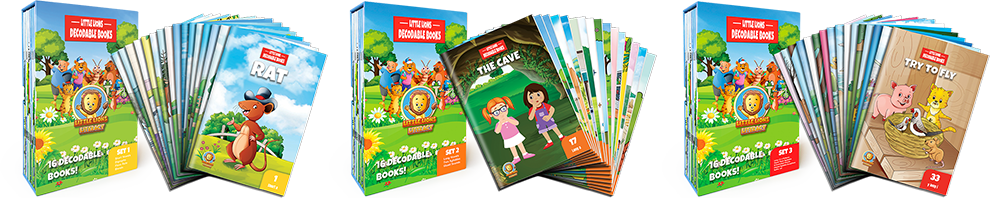
Looking for decodable books that follow a structured phonics progression? Explore the Little Lions Decodable Book sets to find books that match your child’s current reading level.