
If you’ve spent any time helping your child learn to read, you’ve probably come across the term “sight words.” Maybe their teacher sent home a list to practice, or you’ve seen flashcard sets at the store. But what exactly are sight words, and why do they matter so much for early readers? More importantly, how do you know which words your child should be learning at each grade level? Quick answer: Use the grade-by-grade sight words list below to find common words from Pre-K through 3rd grade. Then compare Dolch and Fry lists and use short, phonics-based practice to help the words stick. Looking for structured reading practice? browse our decodable book sets. This guide gives you a complete sight words list organized from pre-K through 3rd grade, explains the difference between the two most popular word lists, and shares practical strategies rooted in the science of reading to help your child learn them with confidence.
Sight words are words that a reader can recognize instantly, without having to stop and sound them out. The term can be a little confusing because it’s used in two different ways. In the science of reading, any word that a child has read enough times to recognize automatically becomes a “sight word.” In that sense, the word “cat” is a sight word once your child knows it by heart. However, in most classrooms and on most parent resource lists, “sight words” refers to a specific set of high-frequency words that appear over and over again in children’s books. Many of these words, like “the,” “said,” and “was,” have irregular spellings that can’t be fully sounded out using basic phonics rules. That’s what makes them tricky, and that’s why they get special attention. When your child can recognize these common words automatically, reading becomes smoother and more enjoyable. Instead of stumbling over “because” or “there” on every page, they can focus their energy on understanding the story. 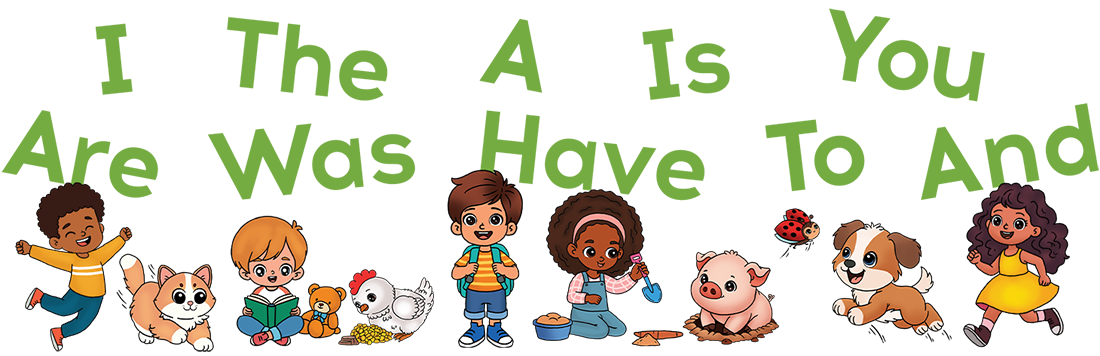
Two sight word lists dominate early literacy: the Dolch list and the Fry list. Both are valuable, but they were created at different times and have slightly different structures.
Quick answer: The Dolch list has 220 words organized by grade level (Pre-K through 3rd grade) and focuses on irregular, hard-to-sound-out words. The Fry list has 1,000 words organized by frequency. Either works well; use whichever your child’s school recommends.
Created by educator Edward William Dolch in 1936, this list contains 220 service words plus 95 common nouns. The words are organized into five levels: pre-primer, primer, first grade, second grade, and third grade. The Dolch list focuses exclusively on words that can’t be easily illustrated or sounded out, making it a go-to resource for words children simply need to know by heart. It remains one of the most widely used sight word lists in schools today.
Dr. Edward Fry updated and expanded the concept in 1957 (revised in 1980), creating a list of 1,000 words organized into groups of 100 by frequency. The first 100 Fry words alone account for roughly 50% of all written text. Unlike the Dolch list, Fry words include both regularly and irregularly spelled words and are organized by how often they appear rather than by grade level. Which list should you use? Either one works well. Many teachers use Dolch because of its clear grade-level organization. If your child’s school sends home a specific list, follow that one. If you’re working independently, the Dolch list’s grade-level groupings make it easy to know where to start.
Below are common sight words your child should work toward mastering at each stage. These draw primarily from the Dolch list, with some overlap from Fry’s first 300 words.
At this stage, children are just beginning to recognize that printed words carry meaning. Start with a small set of the most common words: a, and, away, big, blue, can, come, down, find, for, funny, go, help, here, I, in, is, it, jump, little, look, make, me, my, not, one, play, red, run, said, see, the, three, to, two, up, we, where, yellow, you
Kindergarten is when sight word learning picks up speed. Your child will encounter these words constantly in beginning readers: all, am, are, at, ate, be, black, brown, but, came, did, do, eat, four, get, good, have, he, into, like, must, new, no, now, on, our, out, please, pretty, ran, ride, saw, say, she, so, soon, that, there, they, this, too, under, want, was, well, went, what, white, who, will, with, yes
First graders are reading longer sentences and simple stories. These sight words help them keep up with more complex text: after, again, an, any, as, ask, by, could, every, fly, from, give, going, had, has, her, him, his, how, just, know, let, live, may, of, old, once, open, over, put, round, some, stop, take, thank, them, then, think, walk, were, when
By second grade, children encounter a wider vocabulary. Many of these words have irregular patterns that benefit from direct instruction: always, around, because, been, before, best, both, buy, call, cold, does, don’t, fast, first, five, found, gave, goes, green, its, made, many, off, or, pull, read, right, sing, sit, sleep, tell, their, these, those, upon, us, use, very, wash, which, why, wish, work, would, write, your
Third graders are transitioning from “learning to read” to “reading to learn.” These final Dolch words round out their automatic word bank: about, better, bring, carry, clean, cut, done, draw, drink, eight, fall, far, full, got, grow, hold, hot, hurt, if, keep, kind, laugh, light, long, much, myself, never, only, own, pick, seven, shall, show, six, small, start, ten, today, together, try, warm
Here’s something important that many parents don’t hear: the science of reading tells us that children don’t actually memorize sight words by rote visual memory, the way you might memorize a phone number. Instead, the brain learns words through a process called orthographic mapping.
Key insight: Orthographic mapping happens when a child connects a word’s sounds (phonemes) to its letters (graphemes) and stores that connection in long-term memory. Even “irregular” words like “said” are partially decodable; only the “ai” making an /e/ sound is unexpected.
This means that phonics instruction and decodable reading practice are powerful tools for sight word learning. When your child has strong phonemic awareness and solid phonics skills, their brain is better equipped to map all words, including tricky ones. Decodable books for kindergarten give children the systematic practice they need to build these foundational skills, which in turn makes learning sight words faster and more permanent.
Knowing which words to teach is only half the equation. Here are strategies that work with your child’s brain, not against it:
Even for irregular words, start by having your child identify the sounds they can map. For “were,” they can decode the “w” and the “r.” Point out the tricky part (“the ‘e-r-e’ makes an unusual sound here”) and help them anchor the irregular portion to the regular parts.
Let your child trace words in sand, build them with magnetic letters, or tap out sounds on their arm. Engaging multiple senses helps strengthen the connections in the brain that lead to automatic recognition.
The single best way to turn any word into a sight word is repeated exposure in real reading. When your child encounters “the” hundreds of times across many books, it becomes automatic. This is where decodable books are especially valuable: they give your child controlled, successful reading practice that builds both decoding skills and automatic word recognition at the same time.
Five to ten minutes of focused practice each day is far more effective than a long, draining session once a week. Celebrate effort and progress. If a word isn’t sticking, set it aside and come back to it later.
Flashcards have their place, but words learned in isolation don’t always transfer to real reading. Make sure your child is also reading those sight words in sentences and stories so the knowledge sticks.
It might seem counterintuitive, but one of the best things you can do to help your child learn sight words is to invest in strong phonics and decodable reading practice. When a child builds robust decoding skills, they develop the phonemic awareness and letter-sound knowledge that the brain needs for orthographic mapping. In other words, the better your child gets at sounding out words, the faster all words, including irregular sight words, become automatic. Little Lions decodable books are designed with this science in mind. Each set is carefully sequenced to match your child’s growing phonics knowledge, giving them the successful reading experiences that build confidence and fluency. As they practice decoding in our books, they’re also strengthening the very skills that make sight word learning stick. It’s not an either/or. Phonics practice and sight word mastery work hand in hand. 
Most kindergarteners are expected to master between 20 and 50 kindergarten sight words by the end of the school year, depending on their school’s specific reading curriculum. Standard early literacy benchmarks, such as the Dolch pre-primer list, typically target 40 high-frequency words for this grade level. However, rather than memorizing flat flashcards, the science of reading shows that children learn these ‘Red Words’ best when they are taught through phonics and read in context. To help your young learner build reading confidence, explore our Little Lions First Red Words 10-book set, which is specifically designed for Pre-K and Kindergarten students to practice high-frequency words through simple, engaging stories.
Either list works well. The Dolch list is organized by grade level, making it easy to follow at home. The Fry list is organized by frequency. If your child’s school uses a specific list, follow that one for consistency.
Not exactly. High-frequency words are simply the most common words in English text. Sight words traditionally refer to high-frequency words that have irregular spellings and are difficult to sound out. In practice, the terms are often used interchangeably.
Combine short daily practice (5 to 10 minutes) with real reading. Use multi-sensory activities like tracing in sand or building words with magnetic letters, and make sure your child encounters the words in actual books and sentences, not just flashcards.
Yes. Decodable books build the phonics and phonemic awareness skills that the brain needs for orthographic mapping, which is how all words (including irregular sight words) become automatically recognized. Little Lions decodable book sets are sequenced to match your child’s phonics progression.
Ready to give your child a reading foundation built on science? explore our decodable book sets and see how structured reading practice can transform your child’s confidence and fluency. If you’ve spent any time helping your child learn to read, you’ve probably come across the term “sight words.” Maybe their teacher sent home a list to practice, or you’ve seen flashcard sets at the store. But what exactly are sight words, and why do they matter so much for early readers? More importantly, how do you know which words your child should be learning at each grade level? Quick answer: Use the grade-by-grade sight words list below to find common words from Pre-K through 3rd grade. Then compare Dolch and Fry lists and use short, phonics-based practice to help the words stick. Looking for structured reading practice? browse our decodable book sets. This guide gives you a complete sight words list organized from pre-K through 3rd grade, explains the difference between the two most popular word lists, and shares practical strategies rooted in the science of reading to help your child learn them with confidence.
Sight words are words that a reader can recognize instantly, without having to stop and sound them out. The term can be a little confusing because it’s used in two different ways. In the science of reading, any word that a child has read enough times to recognize automatically becomes a “sight word.” In that sense, the word “cat” is a sight word once your child knows it by heart. However, in most classrooms and on most parent resource lists, “sight words” refers to a specific set of high-frequency words that appear over and over again in children’s books. Many of these words, like “the,” “said,” and “was,” have irregular spellings that can’t be fully sounded out using basic phonics rules. That’s what makes them tricky, and that’s why they get special attention. When your child can recognize these common words automatically, reading becomes smoother and more enjoyable. Instead of stumbling over “because” or “there” on every page, they can focus their energy on understanding the story.
Two sight word lists dominate early literacy: the Dolch list and the Fry list. Both are valuable, but they were created at different times and have slightly different structures.
Quick answer: The Dolch list has 220 words organized by grade level (Pre-K through 3rd grade) and focuses on irregular, hard-to-sound-out words. The Fry list has 1,000 words organized by frequency. Either works well; use whichever your child’s school recommends.
Created by educator Edward William Dolch in 1936, this list contains 220 service words plus 95 common nouns. The words are organized into five levels: pre-primer, primer, first grade, second grade, and third grade. The Dolch list focuses exclusively on words that can’t be easily illustrated or sounded out, making it a go-to resource for words children simply need to know by heart. It remains one of the most widely used sight word lists in schools today.
Dr. Edward Fry updated and expanded the concept in 1957 (revised in 1980), creating a list of 1,000 words organized into groups of 100 by frequency. The first 100 Fry words alone account for roughly 50% of all written text. Unlike the Dolch list, Fry words include both regularly and irregularly spelled words and are organized by how often they appear rather than by grade level. Which list should you use? Either one works well. Many teachers use Dolch because of its clear grade-level organization. If your child’s school sends home a specific list, follow that one. If you’re working independently, the Dolch list’s grade-level groupings make it easy to know where to start.
Below are common sight words your child should work toward mastering at each stage. These draw primarily from the Dolch list, with some overlap from Fry’s first 300 words.
At this stage, children are just beginning to recognize that printed words carry meaning. Start with a small set of the most common words: a, and, away, big, blue, can, come, down, find, for, funny, go, help, here, I, in, is, it, jump, little, look, make, me, my, not, one, play, red, run, said, see, the, three, to, two, up, we, where, yellow, you
Kindergarten is when sight word learning picks up speed. Your child will encounter these words constantly in beginning readers: all, am, are, at, ate, be, black, brown, but, came, did, do, eat, four, get, good, have, he, into, like, must, new, no, now, on, our, out, please, pretty, ran, ride, saw, say, she, so, soon, that, there, they, this, too, under, want, was, well, went, what, white, who, will, with, yes
First graders are reading longer sentences and simple stories. These sight words help them keep up with more complex text: after, again, an, any, as, ask, by, could, every, fly, from, give, going, had, has, her, him, his, how, just, know, let, live, may, of, old, once, open, over, put, round, some, stop, take, thank, them, then, think, walk, were, when
By second grade, children encounter a wider vocabulary. Many of these words have irregular patterns that benefit from direct instruction: always, around, because, been, before, best, both, buy, call, cold, does, don’t, fast, first, five, found, gave, goes, green, its, made, many, off, or, pull, read, right, sing, sit, sleep, tell, their, these, those, upon, us, use, very, wash, which, why, wish, work, would, write, your
Third graders are transitioning from “learning to read” to “reading to learn.” These final Dolch words round out their automatic word bank: about, better, bring, carry, clean, cut, done, draw, drink, eight, fall, far, full, got, grow, hold, hot, hurt, if, keep, kind, laugh, light, long, much, myself, never, only, own, pick, seven, shall, show, six, small, start, ten, today, together, try, warm
Here’s something important that many parents don’t hear: the science of reading tells us that children don’t actually memorize sight words by rote visual memory, the way you might memorize a phone number. Instead, the brain learns words through a process called orthographic mapping.
Key insight: Orthographic mapping happens when a child connects a word’s sounds (phonemes) to its letters (graphemes) and stores that connection in long-term memory. Even “irregular” words like “said” are partially decodable; only the “ai” making an /e/ sound is unexpected.
This means that phonics instruction and decodable reading practice are powerful tools for sight word learning. When your child has strong phonemic awareness and solid phonics skills, their brain is better equipped to map all words, including tricky ones. Decodable books for kindergarten give children the systematic practice they need to build these foundational skills, which in turn makes learning sight words faster and more permanent.
Knowing which words to teach is only half the equation. Here are strategies that work with your child’s brain, not against it:
Even for irregular words, start by having your child identify the sounds they can map. For “were,” they can decode the “w” and the “r.” Point out the tricky part (“the ‘e-r-e’ makes an unusual sound here”) and help them anchor the irregular portion to the regular parts.
Let your child trace words in sand, build them with magnetic letters, or tap out sounds on their arm. Engaging multiple senses helps strengthen the connections in the brain that lead to automatic recognition.
The single best way to turn any word into a sight word is repeated exposure in real reading. When your child encounters “the” hundreds of times across many books, it becomes automatic. This is where decodable books are especially valuable: they give your child controlled, successful reading practice that builds both decoding skills and automatic word recognition at the same time.
Five to ten minutes of focused practice each day is far more effective than a long, draining session once a week. Celebrate effort and progress. If a word isn’t sticking, set it aside and come back to it later.
Flashcards have their place, but words learned in isolation don’t always transfer to real reading. Make sure your child is also reading those sight words in sentences and stories so the knowledge sticks.
It might seem counterintuitive, but one of the best things you can do to help your child learn sight words is to invest in strong phonics and decodable reading practice. When a child builds robust decoding skills, they develop the phonemic awareness and letter-sound knowledge that the brain needs for orthographic mapping. In other words, the better your child gets at sounding out words, the faster all words, including irregular sight words, become automatic. Little Lions decodable books are designed with this science in mind. Each set is carefully sequenced to match your child’s growing phonics knowledge, giving them the successful reading experiences that build confidence and fluency. As they practice decoding in our books, they’re also strengthening the very skills that make sight word learning stick. It’s not an either/or. Phonics practice and sight word mastery work hand in hand.
Most kindergarteners are expected to master between 20 and 50 kindergarten sight words by the end of the school year, depending on their school’s specific reading curriculum. Standard early literacy benchmarks, such as the Dolch pre-primer list, typically target 40 high-frequency words for this grade level. However, rather than memorizing flat flashcards, the science of reading shows that children learn these ‘Red Words’ best when they are taught through phonics and read in context. To help your young learner build reading confidence, explore our Little Lions First Red Words 10-book set, which is specifically designed for Pre-K and Kindergarten students to practice high-frequency words through simple, engaging stories.
Either list works well. The Dolch list is organized by grade level, making it easy to follow at home. The Fry list is organized by frequency. If your child’s school uses a specific list, follow that one for consistency.
Not exactly. High-frequency words are simply the most common words in English text. Sight words traditionally refer to high-frequency words that have irregular spellings and are difficult to sound out. In practice, the terms are often used interchangeably.
Combine short daily practice (5 to 10 minutes) with real reading. Use multi-sensory activities like tracing in sand or building words with magnetic letters, and make sure your child encounters the words in actual books and sentences, not just flashcards.
Yes. Decodable books build the phonics and phonemic awareness skills that the brain needs for orthographic mapping, which is how all words (including irregular sight words) become automatically recognized. Little Lions decodable book sets are sequenced to match your child’s phonics progression.
Ready to give your child a reading foundation built on science? explore our decodable book sets and see how structured reading practice can transform your child’s confidence and fluency.