Every teacher, parent, and reading specialist has been there. You have an emerging or struggling reader who is right on the edge of cracking the code, and you know they need phonetic practice. You search for early reading tools, and two names instantly dominate the conversation: the historic, household staple Bob Books and the modern, evidence-based newcomer Little Lions Literacy.
For over forty years, Bob Books have been a default rite of passage for families teaching kids how to read. But as our understanding of early literacy development has evolved through cognitive science, the educational landscape has shifted. Today, educators and parents are increasingly looking for materials tightly aligned with the Science of Reading (SoR)—a vast body of empirical research showing exactly how the human brain learns to read through explicit, structured phonics instruction.
When evaluating Little Lions Literacy vs Bob Books, which decodable book series actually provides the high-quality decoding practice your child or classroom needs?
Let’s dive into an honest, side-by-side comparison of their phonics scopes, text quality, illustrations, and total educational value to see which box set deserves a spot on your reading table.
Before comparing specific brands, it’s critical to understand the mechanical purpose of a decodable reader. Unlike traditional “leveled books” (which rely on repetitive sentence frames and heavy picture clues that accidentally teach children to guess words), a true decodable book only includes words made up of sound-spelling patterns that a child has already been explicitly taught.
According to research, providing systematic decoding practice directly prevents the development of poor reading habits, such as looking at a picture to guess an unfamiliar word (Reading Rockets). When children use phonics to blend sounds together sequentially, they build a neural pathway called orthographic mapping—the process the brain uses to permanently store words for instant, effortless retrieval.
Learn more about Orthographic Mapping for early readers >>> What Does Orthographic Mapping Mean: A Simple Guide
If a decodable text introduces sound patterns out of order, or relies on vocabulary that is too complex for a beginner, the cognitive load spikes, frustration sets in, and the child defaults back to guessing. That is why the structural layout of Little Lions Literacy vs Bob Books matters immensely.
The backbone of any structured literacy program is its scope and sequence—the explicit, logical order in which letter sounds and spelling rules are introduced. Let’s look at how both brands map out their instruction.
Bob Books Set 1 (Beginning Readers) starts simply enough. The first book uses only four letter sounds (m,a,t,s) to create ultra-basic sentences like “Mat sat.” As the boxes progress, they slowly introduce more consonants and short vowel sounds.
However, many classroom teachers and homeschool parents note a structural hurdle when moving between the various sets and collections. The progression can feel jagged. For instance, children are suddenly hit with complex consonant blends, tricky high-frequency words, or confusing text layouts without an adequate bridge of intermediate practice. Furthermore, the overall sequencing of Bob Books doesn’t always cleanly align with modern, widely adopted school curricula like UFLI, Fundations, or standard Orton-Gillingham frameworks.
Designed explicitly by literacy experts to integrate with modern classroom instructional tracks, Little Lions Literacy follows a meticulously organized, airtight scope and sequence.
Rather than jumping abruptly from simple words to advanced sentences, the collection builds a seamless bridge across its progression:
Read the Full Details >>> Little Lions First Readers
Explore all the Little Lions Decodable Book Sets >>> Little Lions Decodable Books
Because this progression matches the architectural layout of evidence-based phonics instruction, it functions perfectly as a targeted intervention tool for struggling readers, while easily mapping onto existing school curriculum requirements.

How a book is physically laid out on the page directly dictates how a child’s eyes and brain interact with the text. This is an area where Little Lions Literacy vs Bob Books showcase completely opposite design philosophies.
Bob Books intentionally utilize black-and-white or minimally colored stick-figure line drawings. The historic argument for this style was that it removed visual clutter so children would focus strictly on the text. However, because the text and the drawing share the exact same visual field on the page, emerging readers still frequently slide their eyes over to the stick figures to hunt for visual clues instead of tracking the print. Additionally, many modern young learners find the sparse art style dry or unstimulating, making reading sessions feel like a chore.
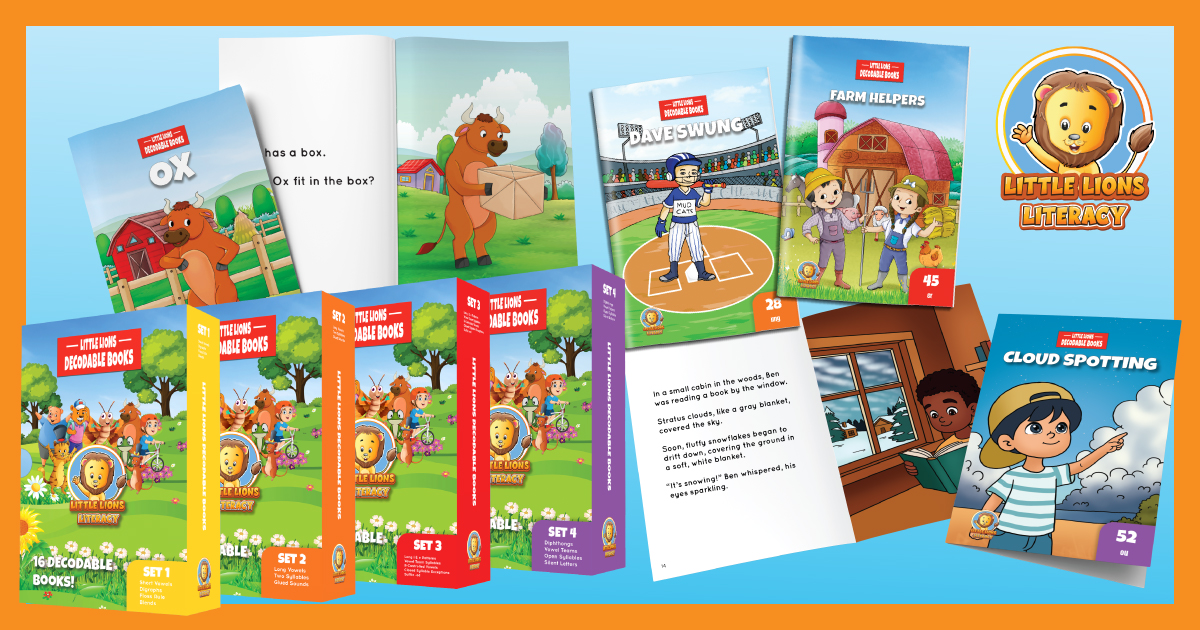
Little Lions Literacy solves this layout problem through brilliant page architecture. The books are designed with a strict physical separation: the text is placed entirely on the left-hand page, and the vibrant, full-color illustration sits on the right-hand page.
This layout allows the child to completely lock their eyes onto the clear, sans-serif text without visual distraction. Once they have successfully decoded the text page, they get the immediate psychological “reward” of looking at the gorgeous, engaging artwork on the opposite side. The presence of actual, lively characters creates genuine narrative engagement, transforming decoding mechanics into real, pleasurable storytelling.

A common critique among reading interventionists is that many early reader sets are just books—they lack instructional wrapping.
When you open a Bob Book, you get the story, and that’s about it. If you want to do sound warm-ups or review tricky sight words, the teacher or parent must write them out on a separate whiteboard or flashcard ahead of time.
Every individual book from Little Lions Literacy is built as a self-contained, comprehensive reading lesson:
Before the story even starts, page one features targeted instructions that introduce the reader to the exact phonograms and high-frequency sight words (or “Red Words“) featured in the upcoming pages. This allows educators and parents to pre-teach and build automaticity before the child encounters the words inside a full sentence, drastically reducing mid-story frustration.
True literacy requires both decoding and language comprehension. At the end of each Little Lions story, there are carefully crafted comprehension questions that push past simple rote recall. Questions like, “What would you change about the story, and why?” invite children to think critically and apply oral language skills.
Following the comprehension questions, the books provide practical, hands-on drawing and writing prompts directly linked to the phonograms studied. This seamlessly connects reading (decoding) with writing (encoding), an absolute necessity for deep orthographic mapping.

For school administrators and classroom teachers looking to maximize their instructional budget, the operational differences between these two options of Little Lions Literacy vs Bob Books are substantial.
Bob Books are typically sold in lightweight cardboard boxes containing small, thin, brief paper booklets. While affordable for a quick home purchase, they easily tear, wrinkle, and get lost in a hectic classroom ecosystem. They are designed primarily for individual use and lack physical durability.
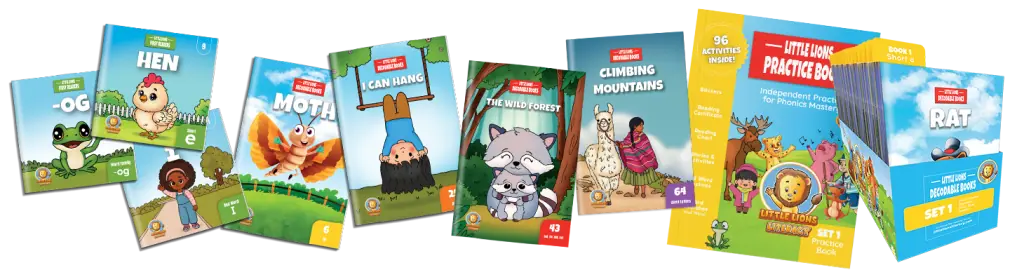
Conversely, Little Lions Literacy offers heavy-duty, robust slipcases for their standard sets, ensuring long-term structural durability on classroom shelves. More importantly, they provide an unmatched Classroom Set framework explicitly engineered for small-group instruction.
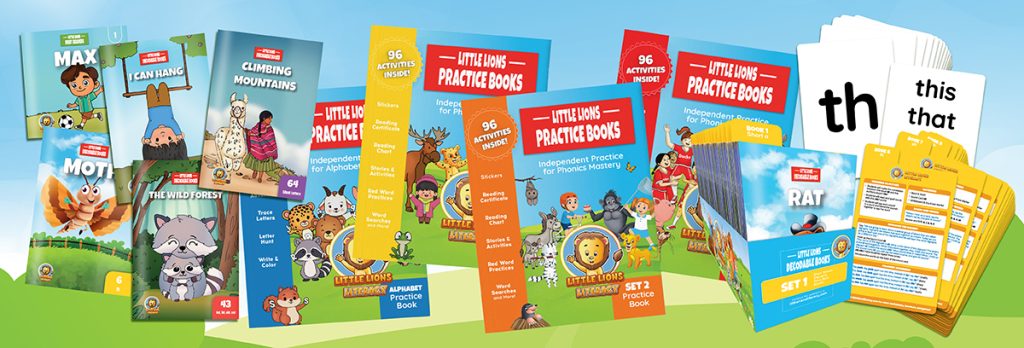
The Little Lions Classroom Set 1, for example, is a complete all-in-one instructional toolkit. Instead of just giving you books, the display box includes
This level of structural support saves educators dozens of hours of prep work every single week. There is no need to print out extra worksheets, cut laminating sheets, or hunt for separate dry-erase tools—the entire evidence-based lesson is packaged and ready to open.
Learn more >>> Little Lions Decodable Books Classroom Sets
While Bob Books will always hold a nostalgic place in the history of early reading, Little Lions Literacy represents the modern evolution of structured literacy tools.
By separating text from imagery to prevent guessing, embedding explicit pre- and post-reading instructional activities into every book, and offering robust classroom toolkits that eliminate hours of prep time for busy teachers, Little Lions provides a noticeably superior educational experience. It doesn’t just give children sentences to string together—it systematically guides them toward comprehensive, lifelong literacy. In the scope of Little Lions Literacy vs Bob Books, the verdict is in. Little Lions wins!
If you are ready to invest in reading tools that pair rigorous educational science with joyful, highly engaging narratives, it’s time to upgrade your instructional shelves. – How to Homeschool
“Little Lions Literacy has become a staple in my kindergarten small groups. The combination of alliterative narratives, vibrant illustrations, and integrated extension activities makes them a powerful tool for reinforcing letter recognition and sound retention. They are a fantastic way to support knowledge building and vocabulary development.” — Beagles & Books
“Little Lions First Readers are a structured, well-designed, and cheerful tool for early reading development. The series gently guides young learners through phonetic patterns, building confidence through thoughtful progression and helpful instructional notes, while playful illustrations bring the stories to life.” — The Children’s Book Review
Explore the complete collection of Decodable Books for Kindergarten and foundational primary classrooms at Little Lions Literacy today, and watch your young learners transform into confident, fluent readers.
What are Structured Literacy Decodable Books
Balanced Literacy vs Science of Reading: What’s Best?
10 Fun Play-Based Phonics Activities for Kids
While Bob Books are technically decodable and focus on phonics rather than whole-language guessing, they lack the explicit pre-reading warm-ups, embedded high-frequency word instruction, and systematic multisensory writing extensions that characterize a comprehensive, modern Science of Reading curriculum.
Yes. Because Little Lions books follow a highly systematic, universal phonics progression, they are easily mapped onto popular structured literacy programs such as UFLI, standard Orton-Gillingham methods, Wilson Fundations, and Heggerty.
Little Lions Literacy is highly recommended for struggling readers and students with processing differences like dyslexia. The intentional separation of text and image prevents guessing habits, the large font is easy to track, and the built-in multi-sensory warm-ups and writing extensions provide the explicit, repetitive practice these students require to successfully anchor graphic print to speech sounds.